For Canadian practices outside Quebec
Jordan’s Principle letter of support: a checklist for therapy clinics
A Jordan’s Principle letter of support from a therapy clinic has one job: to show how the requested service links directly to a First Nations child’s unmet needs. The family or their representative sends the request to Indigenous Services Canada (ISC); the clinic supplies a dated, signed letter from a professional acting within their scope of practice, plus a clear cost breakdown. This guide lists what ISC’s pages ask for and gives your clinic a checklist to complete before the letter leaves the building.
Fictional example only. Adapt this to your clinic’s own policy and professional judgment. It is not clinical, legal or regulatory advice and does not claim to meet any payer, regulator or certification-body requirement. Indigenous Services Canada decides each request, and its requirements can change; read its current pages, and ask the family’s service coordinator, before you rely on this guide.
Last updated: 2026-11-21
By the TherapyCRM team at Data Inn Inc.
Fictional worked example; blank PDF and Word download.
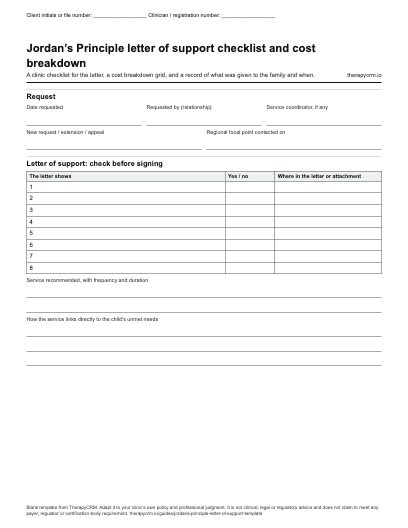
Download a printable Jordan’s Principle letter of support checklist (PDF or Word)
A clinic checklist for the letter, a cost breakdown grid, and a record of what was given to the family and when. The blank PDF prints on US Letter paper (2 pages) and the Word document can be edited to match your clinic’s fields. Both are free to download with no sign-up.
What a clinic is asked for in a Jordan’s Principle request
Jordan’s Principle is the route, run by ISC, through which First Nations children can request the products, services and supports they need. ISC’s request page lists therapeutic services, including speech therapy, physiotherapy and occupational therapy, among the things that can be requested.
- The clinic does not send the request. A parent or guardian, the child at the age of consent, or an authorized representative does.
- The clinic supplies supporting documents: a letter of support, relevant assessments, and a detailed cost breakdown for the service it would provide.
- ISC’s February 2025 operational bulletin says requests must include professional documentation that clearly links the requested item to the child’s needs.
- A service coordinator or navigator can help the family; ask the family whether one is involved before you write.
Who is covered and who sends the request
ISC’s page says a First Nations child under the age of majority in their province or territory, who permanently resides in Canada, can access Jordan’s Principle if the child meets one of four criteria.
- The child is registered or eligible to be registered under the Indian Act.
- The child has one parent or guardian who is registered or eligible to be registered.
- The child is recognized by their nation for the purposes of Jordan’s Principle.
- The child is ordinarily resident on reserve.
Not the clinic’s decision: Eligibility is confirmed by the family and ISC. Do not ask a family to prove status to the clinic, and do not state eligibility in your letter. Inuit children are served through the separate Inuit Child First Initiative.
What the letter of support needs to show
ISC’s pages describe the letter and the professional who writes it. Use this list as the clinic’s review before signing.
- Written by a Canadian health or education professional, or an Elder or Knowledge Keeper, who knows the child and is within the child’s circle of care.
- A health professional acts within their scope of practice and holds a licence or certification in good standing with their regulator.
- Dated and signed by the professional.
- States the child’s identified need or diagnosis, where one exists.
- Names the specific service recommended, with its frequency and duration where that applies.
- Explains how the service links directly to the child’s unmet health, social or educational needs.
- May include the professional’s licence or registration number, where applicable.
- Is supported by relevant assessments or reports, such as a speech and language assessment, an occupational therapy assessment, a treatment plan or a progress report.
A fictional letter outline and cost breakdown
ISC asks for a detailed cost breakdown and assesses whether costs are reasonable and proportional. Give the family one page that a reviewer can read without the clinic’s price list.
The outline and figures below are invented. They show the structure, not wording or prices to copy.
Swipe or scroll sideways to view all table columns.
| Part | What the fictional clinic wrote |
|---|---|
| Who is writing | Speech-language pathologist who assessed the child; college registration number; clinic name and address |
| How the writer knows the child | Completed the assessment and has seen the child for a fictional six sessions |
| Identified need | Summary of assessment findings in two sentences, with the report attached |
| Service recommended | Individual speech therapy, one 45-minute session a week for 24 weeks, then a progress report |
| Link to the child’s needs | What the child cannot yet do, what the therapy targets, and what would be delayed without it |
| Cost breakdown | 24 sessions at a fictional $150 = $3,600; one progress report at $200; total $3,800; no travel or administration charges |
| Payment and contact | Whether the clinic can be paid directly, and who at the clinic answers questions |
List each rate, quantity and subtotal. If a cost is outside typical use, ISC’s page says supporting documentation from a qualified professional is required.
Timelines, payment and reimbursement
Tell the family what ISC’s page says, and do not add your own estimate to it.
- Individual requests: ISC’s page gives 12 hours for urgent requests and 48 hours for other requests, counted from when all necessary information is received. The page also says the department is experiencing delays.
- ISC recommends that families do not pay for services until the request is approved.
- Where possible ISC arranges payment directly with the service provider at no cost to the family. A reimbursement form is used for family reimbursement and for a provider to request direct payment for services rendered.
- ISC’s pages do not state what an invoice must contain or a deadline for sending one. Ask the regional focal point and record the answer on the checklist.
- An approval covers a period. ISC says a previously approved request might not be approved again, and extensions need an updated letter of support.
Decide before the first session what the clinic will do if an approval is late or an extension is not approved, and tell the family in writing.
If a request is denied, or services need to continue
ISC’s page says a denial can be appealed within one year of the date the written denial was sent. The family, the child at the age of consent or an authorized representative sends a written request to the regional focal point.
- The clinic’s part is an updated letter of support or assessment that responds to ISC’s stated reasons.
- Keep the denial letter’s date and reasons on the checklist so the update answers them directly.
- For continuing services, start the updated letter before the approved period ends, using current progress data.
- Record every document the clinic gave the family, with its date, so two versions are not in circulation.
Where TherapyCRM fits, and where it does not
TherapyCRM does not send requests to ISC and has no connection to ISC’s systems. It keeps the clinical and billing records the clinic draws on. TherapyCRM serves English-language practices in Canada outside Quebec. It is practice management software with a clinical record, not a physician EMR, and has no EMR certification. It has no telehealth or video visits and does not submit insurance or government claims or Jordan’s Principle requests.
- Treatment plans, session data and reviewed notes are kept in one client record with dates.
- Published progress reports give the clinician current data for an updated letter.
- Staff create invoices from completed sessions, so an invoice matches the sessions that took place.
- The letter itself, and the decision about what to recommend, stay with the clinician.
Frequently asked questions
Who can write a Jordan’s Principle letter of support?
ISC’s pages name a Canadian health professional, an educational professional, or an Elder or Knowledge Keeper who knows the child. A health professional must act within their scope of practice and be in good standing with their regulator. ISC’s documents page lists speech-language pathologists, occupational therapists, physiotherapists and psychologists among the professionals.
Can a therapy clinic submit a Jordan’s Principle request for a family?
Not as a clinic. ISC lists parents and guardians, the child at the age of consent and authorized representatives with written permission for individual requests. The clinic supplies the supporting documents.
What must a Jordan’s Principle letter of support include?
It must be dated and signed and show how the requested service links directly to the child’s unmet needs. ISC’s documents page adds the identified need or diagnosis, the specific service recommended, its frequency and duration where applicable, and the professional’s licence or registration number where applicable.
Does Jordan’s Principle pay the therapy clinic directly?
ISC’s page says that where possible it arranges the service with the provider at no cost to the family, and that a service provider may be paid directly. A reimbursement form is used to request direct payment for services rendered. Confirm the steps with the regional focal point.
How long does a Jordan’s Principle decision take?
ISC’s page gives 12 hours for urgent individual requests and 48 hours for other individual requests once all necessary information is received, and says the department is experiencing delays. Do not promise a date to a family.
Is ABA therapy covered under Jordan’s Principle?
ISC’s request page lists speech therapy, physiotherapy and occupational therapy as examples of therapeutic services and does not list behavioural therapy there. Its documents page mentions a behavioural therapy assessment as an example of a supporting document. Each request is decided on the child’s needs, so ask the regional focal point.
Run a clinic? Ask for a walkthrough of this workflow
Prefer email? support@therapycrm.ioConnect a guide, a resource and a clinic workflow
Read the explanation, try a fictional example, and review the corresponding product workflow. Browser tools and sheets do not send your entries to TherapyCRM.