For Canadian practices outside Quebec
Pediatric speech therapy evaluation and re-evaluation report
An evaluation report explains the referral question, evidence gathered, limits of that evidence and the SLP’s reasoning. This original three-page outline supports a pediatric initial evaluation or a re-evaluation write-up. The clinician selects the assessment process; the outline contains no test items, diagnostic algorithm, standard scores or recommended treatment frequency.
Fictional example only. Adapt every record to your clinic’s own policy and professional judgment. This is not clinical, legal or regulatory advice and does not claim to meet any payer, regulator or certification-body requirement. The original forms are documentation aids, not assessments, norms or treatment recommendations.
Last updated: 2026-10-10
Download a printable SLP evaluation report outline (PDF or Word)
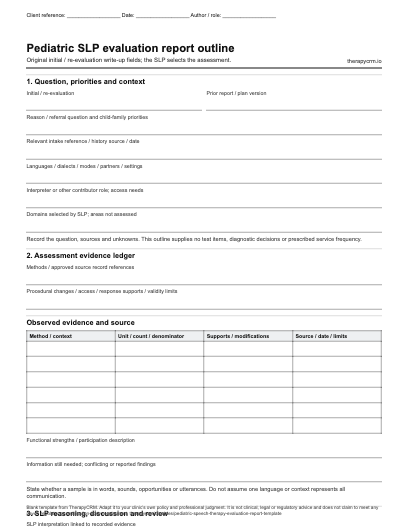
Original initial / re-evaluation write-up fields; the SLP selects the assessment. The blank PDF prints on US Letter paper (3 pages) and the Word document can be edited to match your clinic’s fields. Both are free to download with no sign-up.
Separate intake information from the evaluation question
Use the established intake record for history and consent information, then identify the question this evaluation should answer. Name who provided each relevant report and its date. A caregiver concern, a referral label and an observed finding are different kinds of evidence. Copy only what is relevant and confirm the current information.
- State whether this is an initial evaluation or re-evaluation and why it is taking place.
- Record the child/family’s communication priorities and preferred ways of communicating.
- Document relevant languages, dialects, settings, partners and interpreter involvement.
- Describe methods used, conditions and modifications before interpreting results.
- Link the SLP’s conclusion, unresolved questions and next steps to the evidence recorded.
Define the fields in the SLP evaluation report
Remove irrelevant domains instead of marking them normal when they were not assessed. Distinguish “not assessed”, “not interpretable under these conditions” and an observed finding. The outline has room for the clinician’s decision without supplying that decision.
Swipe or scroll sideways to view all table columns.
| Field | What to record and why |
|---|---|
| Purpose and priorities | Referral question, evaluation type, child/caregiver priorities and current plan reference. |
| Context and contributors | Language/dialect history, communication modes, source/role/date of information and interpreter role. |
| Evidence ledger | Method and approved record location, task/context, observed counts, supports and procedural changes. |
| Functional description | What communication supports or limits participation in the named contexts; strengths included. |
| Reasoning and limits | SLP interpretation, conflicting information, unassessed areas and limits on generalization. |
| Discussion and next steps | What was discussed, clinician-selected actions, responsibility, review date and author/sign-off. |
Handle samples, denominators and multilingual information
For any custom probe or sample percentage, include numerator, eligible denominator, observation rule, language, partner and support. Identify the unit—opportunity, word, sound or utterance. Keep teaching-supported observations separate from an unprompted probe.
Language samples and interpreter collaboration can inform the SLP’s assessment. Document what was obtained in each language and what remains unknown. Do not treat limited English exposure as proof of disorder or translate a licensed test and present the result as a validated standard score. Follow the instrument’s permitted procedures and report limitations when changes affect interpretation.
Fictional completed SLP evaluation outline
This invented outline deliberately leaves diagnosis and service decisions to the evaluating SLP. It demonstrates a traceable report with an unresolved question rather than a ready-made clinical conclusion.
Swipe or scroll sideways to view all table columns.
| Record field | Fictional completed entry |
|---|---|
| Purpose and priorities | Initial evaluation on 10 October 2026; family asks how to support understandable messages during chosen play and everyday routines. Client C prefers picture-supported choices. |
| History and language context | Caregiver describes English and another home language used with different relatives. This encounter observed English only; interpreter-supported information gathering in the home language remains to be arranged. Intake record referenced, not duplicated. |
| Methods and record location | Caregiver interview, clinician observation and an original eight-opportunity message probe; source logs stored in the practice-approved record. No standardized score reported. |
| Observed evidence | Eight eligible observed opportunities: three target messages without response prompt, two after a model, three other observed outcomes. Picture access available throughout. Independent category 3/8 (37.5%), supported category 2/8 (25%). |
| Functional summary | Messages were observed with a familiar adult in chosen play. Caregiver reports different participation in home routines; this report is not presented as a counted clinic observation. |
| Reasoning and limits | SLP records that the single context and English-only evidence do not characterize communication across all settings/languages. Diagnostic interpretation remains the evaluating SLP’s responsibility after the chosen assessment process. |
| Discussion, plan and review | Family priorities reviewed; clinician to gather additional agreed context/language information and discuss findings at review on 24 October 2026. Authored by fictional evaluating SLP; signature/credentials completed within the clinic record. |
Fictional documentation example. Counts illustrate recording rules, not age expectations, diagnosis, mastery or a recommended therapy plan.
Use the same outline for re-evaluation with a comparison ledger
For re-evaluation, identify the new clinical question and the prior report/plan version. Compare only evidence whose methods and conditions support comparison. State changes in supports, languages, materials or sample size; do not attribute change to therapy solely because one number increased.
Record what has been reviewed, what was reassessed and what was not. The clinician decides whether new assessment is indicated and what the results mean. A routine progress report is not automatically a re-evaluation. This pack supplies no required reassessment interval or payer authorization criteria.
Common evaluation report mistakes
Before signing, follow the evidence from each conclusion back to its source. A template should reveal uncertainty rather than make every field sound conclusive.
- Writing “within normal limits” for an area not assessed.
- Omitting language, interpreter, mode or accommodation details.
- Using custom percentages as diagnostic cutoffs or age norms.
- Copying assessment items, proprietary protocols or test-score conversions into the outline.
- Repeating history without saying who reported it or whether it was verified.
- Applying US payer documentation schedules to a Canadian clinic without checking the applicable requirements.
Review, share and connect the report to the plan
Use fictional or de-identified information in public tools. Keep identifiable records in a practice-approved system, with the permissions, consent process and retention rules applicable to your setting. A client reference can still identify someone within a practice.
The evaluating SLP reviews and signs the report under the applicable professional and practice process. Record what was explained in accessible language, what questions remain and what next step was actually agreed. Use the treatment-plan owner for clinician-selected goals rather than inserting a generic goal set from an outline.
Professional sources and limits
The workflow, blank forms and fictional examples on this page are original editorial material. The sources below support the professional context; they have not reviewed or endorsed this pack.
The documentation approach is educational material for English-language readers in Canada and the United States. Ontario regulator sources apply to Ontario registrants; ASHA and AOTA resources are professional guidance and do not establish Canadian legal requirements. TherapyCRM serves practices in Canada outside Quebec. It does not submit insurance or government claims.
Primary professional and regulator sources
- [OTSLP-ASSESS] ASHA: Assessment Tools, Techniques, and Data Sources. Professional overview of observation, samples and other assessment information; checked 10 October 2026. The forms here are original and do not reproduce tests.
- [OTSLP-LANG] ASHA: Multilingual Service Delivery. Language history, interpreter collaboration and limits on cross-language score interpretation; checked 10 October 2026.
- [OTSLP-DOC] ASHA: Documentation in Health Care. Distinguishes clinical documentation types and setting-specific requirements. A US professional resource, not a universal reporting schedule; checked 10 October 2026.
- [OTSLP-CASLPO] CASLPO: Records. Ontario regulator’s records resources for audiologists and SLPs; checked 10 October 2026. Read the applicable requirements before clinical use.
Frequently asked questions
Is this a speech-language assessment?
No. It is an original report-writing outline. A qualified SLP selects the assessment methods, interprets the evidence and makes any clinical decisions.
Can I use it for re-evaluation?
Yes. Identify the reason, prior report/plan version, comparison conditions, new evidence and unresolved questions. The outline does not determine whether re-evaluation is indicated.
Does it include standardized test items or scoring?
No. It contains no licensed items, protocols, score conversions or norms. Use authorized instruments within their terms and procedures.
How should multilingual information be recorded?
Name languages/dialects and contexts, information sources, interpreter involvement, methods used and evidence gaps. Keep language-specific samples and limits explicit; do not assume one language describes every context.
Can this replace an intake form?
No. Link relevant history and consent from the intake record. The evaluation report explains the assessment question, evidence and the SLP’s reasoning.
Will this satisfy insurance or school requirements?
No universal requirement is claimed. The clinician/practice checks the current professional, setting, school and payer requirements applicable to that particular service.