For Canadian practices outside Quebec
Pediatric occupational therapy evaluation report outline
An OT evaluation report connects what matters in everyday life with assessment evidence and the OT’s reasoning. This original three-page outline organizes a pediatric evaluation or re-evaluation write-up. Its questions, order and layout are independently written; it does not reproduce AOTA’s occupational profile form or substitute for a clinician-selected assessment.
Fictional example only. Adapt every record to your clinic’s own policy and professional judgment. This is not clinical, legal or regulatory advice and does not claim to meet any payer, regulator or certification-body requirement. The original forms are documentation aids, not assessments, norms or treatment recommendations.
Last updated: 2026-10-10
Download a printable OT evaluation report outline (PDF or Word)
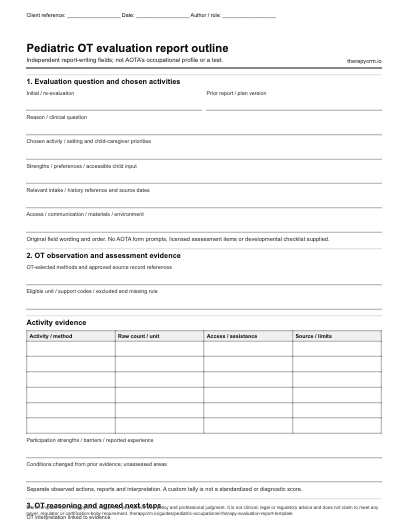
Independent report-writing fields; not AOTA’s occupational profile or a test. The blank PDF prints on US Letter paper (3 pages) and the Word document can be edited to match your clinic’s fields. Both are free to download with no sign-up.
Frame the evaluation around participation priorities
Record the referral question alongside the child’s and caregiver’s selected priorities. Describe the everyday activity in its setting before listing observations. The OT decides which assessment information is needed and whether further information, adaptation or referral is appropriate.
- Identify initial evaluation or re-evaluation, reason and current plan/report reference.
- Describe the chosen daily activity, preferences, strengths and relevant history source.
- Record observation/assessment methods and actual environmental and response supports.
- Separate directly observed evidence, information reported by others and interpretation.
- Write the OT’s reasoning, limits, agreed next steps and review/sign-off.
Define the original OT report fields
A meaningful-activity summary is not a standardized occupational profile or developmental score. If a licensed instrument is used, record its name and approved result location according to its terms; do not paste its items into this form.
Swipe or scroll sideways to view all table columns.
| Field | What to record and why |
|---|---|
| Question and chosen activity | Reason for evaluation, activity/setting and child/caregiver priorities. |
| Context and evidence sources | Contributors, source dates, relevant history, equipment and communication/access needs. |
| Observation ledger | Methods, activity conditions, defined units, raw observations and assistance actually used. |
| Participation description | Strengths, barriers and the child’s experience; distinguish reported and observed information. |
| OT reasoning and uncertainty | Interpretation linked to the evidence, unassessed areas and other information needed. |
| Agreement and next steps | Clinician-selected recommendations, what was discussed, ownership, review and author/sign-off. |
Keep assistance, counts and context with the findings
Describe usual access supports separately from response assistance. For a step tally, define the eligible observed steps and each outcome. A child can perform a step without response assistance while using an agreed access support; the report needs the definition instead of an unexplained “independent” label.
Raw counts, minutes, work-sample features and a person’s experience measure different things. State the unit and denominator where applicable. A custom observation percentage has no normative or diagnostic meaning. Missing observations, declined activities and unavailable access remain visible, with the rule for any exclusion.
Fictional completed OT evaluation outline
Client D’s invented report shows how observed activity and reported information can coexist without becoming a diagnosis or a preset treatment plan.
Swipe or scroll sideways to view all table columns.
| Record field | Fictional completed entry |
|---|---|
| Purpose and priorities | Initial OT evaluation on 10 October 2026; child and caregiver choose organizing drawing materials as the activity they want to discuss. Earlier intake history referenced. |
| Contributors and context | Child preference recorded through accessible choices; caregiver describes routines at home. Observation at a familiar table, usual visual sequence available. |
| Methods and evidence ledger | Caregiver discussion and six-step activity observation; original step log in the approved record. No standardized instrument or score reported in this fictional entry. |
| Counts and assistance | Six planned steps: three completed without response assistance, two completed with recorded adult help, one declined. Five eligible observed steps under the written rule: 3/5 independent category, 2/5 assisted category. |
| Functional description | Child participated in five steps and chose to stop before the sixth. Caregiver reports a quieter home table helps; this is labelled reported information, not a measured treatment effect. |
| Reasoning and limits | Observation describes this routine and its supports. It does not establish sensory, motor or executive-function diagnoses or performance in unobserved settings. OT to decide further assessment and interpretation. |
| Discussion, next step and review | Priorities and missing-context information discussed. OT to review additional agreed context information on 24 October 2026 before setting the individualized plan. Fictional author/credentials completed through the practice’s signing process. |
Fictional documentation example. Counts illustrate recording rules, not age expectations, diagnosis, mastery or a recommended therapy plan.
Document re-evaluation and sensory or work-sample evidence
A re-evaluation adds a current question and an explicit link to prior findings. Record whether the activity, equipment, observation window and support rule are comparable. Explain why methods changed and how that limits a numeric comparison.
Sensory-related history or observation may be relevant to participation, but this outline supplies no sensory profile scoring, sensory-diet plan or conclusions from isolated actions. For handwriting or another work sample, retain the task and support conditions plus the OT-selected method. Unassessed domains stay unassessed.
Common OT evaluation write-up mistakes
Review the reasoning, not just whether every box contains text. The completed report should make it possible to see how the OT reached a conclusion.
- Using a generic developmental checklist as if it were a validated evaluation.
- Copying AOTA’s occupational profile prompts or a publisher’s assessment items into a new product form.
- Calling a sensory observation a sensory diagnosis.
- Omitting the assistance, access supports or conditions behind a score.
- Reporting a caregiver account as direct clinician observation.
- Choosing a treatment frequency or goal solely because a template included a placeholder.
Finalize the report and connect it to care
Use fictional or de-identified information in public tools. Keep identifiable records in a practice-approved system, with the permissions, consent process and retention rules applicable to your setting. A client reference can still identify someone within a practice.
The OT reviews the evidence, clinical interpretation and recipient permissions before signing/sharing. Record the discussion with the child/caregiver and any unanswered questions. The report and agreed goals belong with their plan version; a handoff should identify who will act on the next step.
Professional sources and limits
The workflow, blank forms and fictional examples on this page are original editorial material. The sources below support the professional context; they have not reviewed or endorsed this pack.
The documentation approach is educational material for English-language readers in Canada and the United States. Ontario regulator sources apply to Ontario registrants; ASHA and AOTA resources are professional guidance and do not establish Canadian legal requirements. TherapyCRM serves practices in Canada outside Quebec. It does not submit insurance or government claims.
Primary professional and regulator sources
- [OTSLP-OTASSESS] AOTA: Evaluation and Assessment. Professional description of synthesizing information about meaningful occupations and observed performance; checked 10 October 2026.
- [OTSLP-COTOASSESS] COTO: Standard for Assessment and Intervention, 2023. Ontario regulator source for assessment, plans and review within the OT’s professional responsibilities; checked 10 October 2026.
- [OTSLP-COTORECORDS] COTO: Standard for Record Keeping, 2023. Ontario OT record-keeping standard; checked 10 October 2026. This original pack is not a regulator form.
- [OTSLP-OUT] AOTA: Intervention outcomes. Professional overview of outcomes and review of occupational performance; checked 10 October 2026. The invented counts below are not outcome instrument scores.
Frequently asked questions
Is this the AOTA occupational profile template?
No. It is an independently written evaluation-report outline with its own fields and layout. It does not reproduce or license AOTA’s form.
Does it include pediatric OT tests or norms?
No. An OT selects authorized assessments and interprets the results. This outline contains no proprietary items, protocols or normative scoring.
Can it be used for OT re-evaluation?
Yes, as a write-up outline. State the clinical question, prior report, new evidence and comparison limits. It does not determine whether or when reassessment is necessary.
How should sensory participation be documented?
Record the meaningful activity, context, reported experience, observable actions and supports. Keep assessment interpretation with the OT and avoid diagnostic conclusions from a worksheet tally.
What belongs in a participation baseline?
The defined activity and unit, source/date, observation window, access supports, assistance, raw findings and missing data. Use the same definition when comparison is clinically appropriate.
Can this meet a payer’s evaluation requirements?
No payer requirement is claimed. The clinician/practice checks the current requirements for its jurisdiction, service, setting and payer before using an outline.