For Canadian practices outside Quebec
Therapy referral and clinical handoff documentation
A clinical handoff needs a clear question and a clear receiving-service response. This original two-page pack records a focused referral summary, the agreed sharing scope and acknowledgement/next-step ownership. It is distinct from a case-conference note: sending a summary does not show that another service accepted a referral or assumed responsibility.
Fictional example only. Adapt every record to your clinic’s own policy and professional judgment. This is not clinical, legal or regulatory advice and does not claim to meet any payer, regulator or certification-body requirement. The original forms are documentation aids, not assessments, norms or treatment recommendations.
Last updated: 2026-10-10
Download a printable clinical handoff record (PDF or Word)
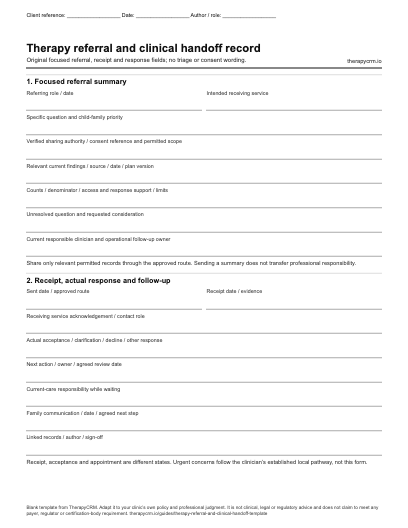
Original focused referral, receipt and response fields; no triage or consent wording. The blank PDF prints on US Letter paper (2 pages) and the Word document can be edited to match your clinic’s fields. Both are free to download with no sign-up.
Prepare a focused referral question
Identify what the referring clinician is asking the receiving service to consider and why the information is relevant. The qualified professionals choose the referral pathway and any urgency through their local process. This template does not triage a child or set a required response deadline.
- Confirm the intended recipient/service and the current client/caregiver priorities.
- Verify the applicable sharing authority, consent scope and practical transmission process.
- Select the relevant current evidence, its source dates and the plan version.
- State the specific question, what remains unknown and who remains responsible while waiting.
- Send through the approved route and record receipt separately from acceptance.
- Record the receiving service’s actual response and tell the family the agreed next step.
Define referral and receiving-service fields
Include only the information relevant to the purpose and permitted sharing scope. A summary should reference supporting records rather than indiscriminately copying a complete file. Avoid using a public worksheet as a transmission channel.
Swipe or scroll sideways to view all table columns.
| Field | What to record and why |
|---|---|
| Purpose and recipient | Specific question, referring role, intended service and current priority. |
| Sharing scope | Verified authority/consent reference, intended records, recipient and transmission route. |
| Current evidence | Relevant findings, source/date, count/unit, support/context and current plan version. |
| Unresolved question | What the evidence cannot answer and what is being requested. |
| Responsibility while waiting | Who manages the current plan and who will track the referral’s status. |
| Receipt and response | Sent/received dates, acknowledgement, actual acceptance or other response, next action/owner and family communication. |
Keep measurement and professional interpretation traceable
Carry the relevant raw count, denominator and support conditions into the summary rather than replacing them with a vague “improving”. Label clinician observation, caregiver report and licensed assessment results. A receiving clinician should be able to find the original evidence in the approved records shared for that purpose.
Do not translate another discipline’s observation into a diagnosis. Unobserved, declined or interrupted activities remain visible. “Independent” must retain its access and response-assistance definition. If no comparable quantitative measure exists, write a contextual description without inventing a percentage.
Fictional completed referral and handoff
Client G’s invented handoff asks for OT input on access to a communication activity. It demonstrates a documentation workflow, not a recommended referral, urgency level or clinical conclusion.
Swipe or scroll sideways to view all table columns.
| Record field | Fictional completed entry |
|---|---|
| Question and priority | 10 October 2026; fictional SLP asks receiving OT service to consider access barriers in Client G’s chosen communication activity. Family priority and current SLP plan version 3 referenced. |
| Sharing record | Practice has verified applicable sharing authority and recorded the agreed recipient/purpose/scope in its approved consent record. Only the selected summary and referenced observation are sent through the approved route. |
| Evidence summary | One familiar-partner observation: five eligible message opportunities, two without response model, two after model, one other outcome. Usual access assistance described. These are separate categories, not a diagnosis or global ability score. |
| Unknown and request | Access in other positions/settings has not been assessed in this record. Receiving OT asked to advise on its assessment pathway; no equipment or strategy prescribed by the referring template. |
| Responsibility pending response | SLP retains responsibility for the current SLP plan. Practice coordinator tracks status; sending the summary does not transfer responsibility. |
| Receipt and response | Receiving service acknowledges receipt on 12 October 2026 and requests clarification of the observation context. Acceptance/appointment not yet confirmed; no status inferred from receipt alone. |
| Next action and family update | Referring clinician to provide the permitted clarification; coordinator to record the service’s subsequent response. Family informed of the actual pending status and agreed contact route. Review set for 24 October 2026 through the fictional practice’s process. |
Fictional documentation example. Counts illustrate recording rules, not age expectations, diagnosis, mastery or a recommended therapy plan.
Distinguish referral, shared plan and case conference
A referral requests a receiving service’s consideration; a handoff records the information transfer and actual response. A shared plan records agreed goals and discipline responsibilities. A case conference records participants, discussion and actions. Keep these related records linked without implying that a meeting or delivered message establishes acceptance.
When a receiving service accepts or declines, record its actual wording/status, responsible contact role and next action. An urgent concern follows the clinician’s established local pathway rather than waiting for a routine template review.
Common clinical handoff mistakes
Check that the record answers what was sent, why, to whom and what happened after it was sent. Avoid status labels that overstate the evidence.
- Sending the entire file without checking relevance and sharing scope.
- Recording “accepted” when only delivery or receipt was confirmed.
- Leaving current care or follow-up responsibility unclear.
- Sharing counts without denominator, context or support conditions.
- Copying an old plan without its version/date or unresolved questions.
- Using a worksheet to prescribe triage timing, legal consent language or another discipline’s assessment.
Review sharing and close the follow-up loop
Use fictional or de-identified information in public tools. Keep identifiable records in a practice-approved system, with the permissions, consent process and retention rules applicable to your setting. A client reference can still identify someone within a practice.
The responsible clinician/practice verifies recipient, contents and sharing authority. Record transmission, receipt, response, family communication and the next action in the approved system. The original form makes these stages visible; it does not establish their legal sufficiency or automate acceptance.
Professional sources and limits
The workflow, blank forms and fictional examples on this page are original editorial material. The sources below support the professional context; they have not reviewed or endorsed this pack.
The documentation approach is educational material for English-language readers in Canada and the United States. Ontario regulator sources apply to Ontario registrants; ASHA and AOTA resources are professional guidance and do not establish Canadian legal requirements. TherapyCRM serves practices in Canada outside Quebec. It does not submit insurance or government claims.
Primary professional and regulator sources
- [OTSLP-DOC] ASHA: Documentation in Health Care. Distinguishes clinical documentation types and setting-specific requirements. A US professional resource, not a universal reporting schedule; checked 10 October 2026.
- [OTSLP-COTOASSESS] COTO: Standard for Assessment and Intervention, 2023. Ontario regulator source for assessment, plans and review within the OT’s professional responsibilities; checked 10 October 2026.
- [OTSLP-COTORECORDS] COTO: Standard for Record Keeping, 2023. Ontario OT record-keeping standard; checked 10 October 2026. This original pack is not a regulator form.
- [OTSLP-CASLPO] CASLPO: Records. Ontario regulator’s records resources for audiologists and SLPs; checked 10 October 2026. Read the applicable requirements before clinical use.
Frequently asked questions
Is this an intake or consent form?
No. It references the practice’s verified sharing authority/consent record and documents a focused clinical transfer. The intake owner covers case history and consent workflow.
Does receipt mean a referral was accepted?
No. Record delivery, acknowledgement and the receiving service’s actual response separately. Acceptance, appointment and transferred responsibility must not be inferred from receipt alone.
Who remains responsible while a referral is pending?
Record the current responsible clinician and operational follow-up owner explicitly. The template cannot decide or transfer professional responsibility.
Can SLP and OT use this for multidisciplinary handoffs?
Yes, after the responsible professionals choose the pathway and permitted information. Label each discipline’s evidence and interpretation, and link any shared plan.
Does it set urgent referral timelines?
No. Qualified clinicians use their established local pathway for urgent concerns. The original pack supplies no triage rules or mandatory response period.
Does it satisfy privacy or payer requirements?
No universal requirement is claimed. The practice verifies the applicable sharing, professional, setting and payer requirements for the particular handoff.