For Canadian practices outside Quebec
Ontario Autism Program invoice template: field checklist and fictional example
An Ontario Autism Program invoice template helps a clinic give families an invoice they can keep and use when they report expenses. On the Ontario Autism Program pages we read, the Ministry does not list a minimum set of invoice fields for core clinical services, so this template shows common practice and is not a rule or a government form. Download the blank layout as a PDF or Word document, then use the field checklist and the fictional example to adapt it.
Fictional example only. Adapt this to your clinic’s own policy and professional judgment. It is not clinical, legal or regulatory advice and does not claim to meet any payer, regulator or certification-body requirement. It is not a government form, and the Ministry sets no required invoice layout on the pages we read.
Last checked: 2026-10-08
Download a printable Ontario Autism Program invoice template (PDF or Word)
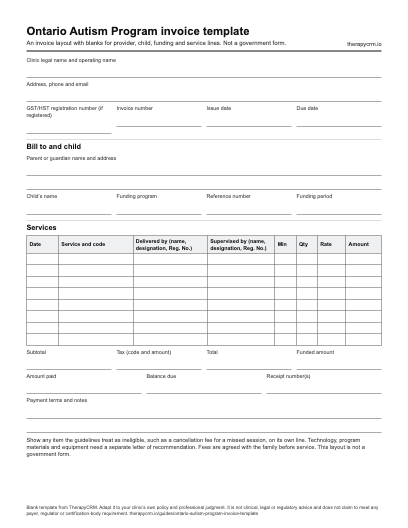
An invoice layout with blanks for provider, child, funding and service lines. Not a government form. The blank PDF prints on US Letter paper (1 page) and the Word document can be edited to match your clinic’s fields. Both are free to download with no sign-up.
What the Ministry says about invoices and expense reporting
Ontario Autism Program core clinical funding is issued to families, and AccessOAP checks the expenses families report against the funding they received [R2]. Families whose funding came from AccessOAP report expenses through their AccessOAP account, and families funded directly by the Ministry submit an expense form [R2]. For families who submit that form, the Ministry says to keep original receipts, invoices and proof of payment for seven years from the date shown on the invoice or receipt [R2].
The guidelines say all fees should be established, well communicated and agreed by both the family and the provider before service starts [R1]. They do not describe an invoice layout. The one invoice rule they state is that an invoice for technology, program materials or equipment must be accompanied by a letter of recommendation from a regulated professional [R1].
The closest published list of proof-of-purchase items sits in the terms for interim one-time funding, a different and older funding stream. If a family is audited, the documents must show at least an invoice or receipt number, the service provider’s name, the clinician’s name, title and licence number where applicable, the services with quantity and individual cost, and the dates the services were provided [R3]. The pages we read do not say whether that list applies to core clinical services, so treat it as a guide to common practice, not a confirmed requirement.
Ask AccessOAP or the Ministry what a family needs before relying on any layout, including this one.
Ontario Autism Program invoice template: field checklist
Use the checklist to build the clinic’s own OAP invoice template. The last column states what a TherapyCRM invoice shows today; a clinic that uses another system can ignore it.
| Invoice field | What to put there | In a TherapyCRM invoice |
|---|---|---|
| Clinic identity | Legal name and operating name if they differ, address, phone and email, and the GST/HST registration number if the clinic is registered | Yes, from the practice’s billing identity; the GST/HST number prints only when the practice is registered |
| Invoice number and dates | A unique invoice number, the issue date, the service date and the due date | Yes |
| Bill to and child | The parent or guardian who pays, with their address, and the child’s name | Yes, with the bill-to guardian chosen on the invoice |
| Funding program, reference number and period | The program name, the reference number the family gives the clinic and the funding period dates | Yes, in a Funding block copied from the funding record staff entered |
| Line date, description and service code | The date each service was delivered, what was delivered in words a family can read, and the clinic’s service code | Yes, one date, description and service code per line |
| Duration, quantity, rate and amount | Minutes, quantity, rate and amount for each line | Yes, per line |
| Delivering clinician | Name, designation and registration number of the person who delivered the service | Yes, per line, from the staff member’s billing credential |
| Supervising clinician | Name, designation and registration number of the supervisor for supervised work | Yes, as Supervised by on the line when a supervisor is recorded |
| Tax | Tax treatment for each line and the tax totals, confirmed by the clinic’s accountant | Yes, with tax codes per line when the practice uses per-line tax |
| Funded amount | The part of the invoice the family expects to cover from its funding allocation | Yes, in the Funding block; it does not reduce the balance due |
| Payments and receipt numbers | Each payment received, its date and method, and the receipt number | The invoice shows the amount paid; each family payment creates a numbered receipt |
| Items that are not eligible expenses | Any item the guidelines list as ineligible, on its own line | Practices mark each service as eligible, not eligible or needs a letter in their billing catalog |
The clinic decides its layout. The Ministry pages we read list no minimum invoice fields for core clinical services.
Fictional example invoice lines
The lines below are invented for one child, Client A, and every rate and amount is a placeholder because fees are agreed between the clinic and the family before service [R1]. The fourth line shows a late cancellation fee on its own line; the guidelines list such fees as ineligible, so the family should be able to see it apart from the rest.
Under the lines, the invoice shows the subtotal, tax, total, amount paid and balance. The fictional Funding block reads: Ontario Autism Program; OAP reference number [number]; funding period [start date] to [end date]; funded amount [amount].
| Line | Date | Service and code | Delivered by | Minutes | Quantity | Rate and amount |
|---|---|---|---|---|---|---|
| 1 | [service date] | Direct service session ([service code]) | Behaviour technician, [title]; supervised by [supervisor name], [designation], Reg. No. [number] | 60 | 1.00 | [rate] and [amount] |
| 2 | [service date] | Parent consultation ([service code]) | [Supervisor name], [designation], Reg. No. [number] | 30 | 0.50 | [rate] and [amount] |
| 3 | [service date] | Session documentation and report writing ([service code]) | [Supervisor name], [designation], Reg. No. [number] | 15 | 0.25 | [rate] and [amount] |
| 4 | [service date] | Late cancellation fee (not an eligible expense) | Not applicable | — | 1.00 | [amount] |
The child, minutes and lines are invented. They do not show a typical session, a recommended mix of services or any rate.
Show supervised work clearly on the invoice
Many Ontario Autism Program services are delivered by technicians under a supervising clinician. The College of Psychologists and Behaviour Analysts of Ontario standards say a supervisee’s services must be clearly noted on invoices and receipts, and that invoices and receipts for supervised services are issued in the name of the supervising member, the supervisor’s employer or the supervisor’s professional corporation, unless the supervisee holds a certificate of registration for autonomous practice [R4]. They also say the invoice must name the supervising registrant and give the supervised provider’s name, relevant degrees and professional designations [R4].
The Delivered by column and the Supervised by detail on each line carry that information. Other Ontario colleges set their own rules for work done by assistants and students, so each clinician’s regulator matters. The fee and receipt rules table lists what each regulator’s published standard says, with official links.
Items that are not Ontario Autism Program expenses
The guidelines list ineligible expenses, and the five below come from that list [R1]. They affect how a clinic lays out an invoice, because anything ineligible is easier for a family to separate when it sits on its own line. The Ministry may change the list at its sole discretion, so check the current page.
- Cancellation fees for missed or cancelled sessions
- Services and supports bought outside the funding period, including before the start date or after the end date
- Services delivered or supervised by a primary caregiver
- Diagnostic assessments and psychoeducational assessments
- Fees for providers or other organizations to manage the budgeting and payments of a family’s allocation
Numbered receipts, the expense summary and record keeping
A clinic looking for an Ontario Autism Program invoice receipt template needs two documents: the invoice above and a receipt for each payment. In TherapyCRM, each cash, cheque, card, bank transfer or e-transfer payment from a family creates a numbered receipt, counting up from RCT-000001 for the practice. Staff, the family portal and the family app can download it. The first download is the original and later downloads are marked COPY, and a reversed payment marks its receipt VOID. Insurer payments do not create receipts.
For a family-paid funding period, TherapyCRM can also produce an OAP expense summary. It is a PDF that lists each issued invoice linked to the period with service dates, number of sessions, expense category, clinician details, total with tax, funded amount and receipt numbers. Lines the practice marked not eligible, dated outside the period or missing a service date are listed separately as not included. Staff and guardians with billing access can download it.
The summary is TherapyCRM’s own layout for the family’s records. It is not a government form, not the Ministry expense form, and it is not sent to AccessOAP or the Ministry. The clinic keeps its own copies under the record-keeping rules of its regulators and its privacy policy; the retention table lists the periods by province.
What this template does not do
The template is a layout for the clinic to adapt. It does not replace the Ministry’s guidance, and it does not make a clinic’s invoices acceptable to any funder. The Ministry says fees are agreed between the family and the provider before service [R1], and it may change its lists of eligible and ineligible expenses at its sole discretion [R1].
- It is not a government form and not the Ministry expense form.
- It states no required invoice layout, because the pages we read list none.
- It sets no fee or rate; fees are agreed between the clinic and the family before service.
- TherapyCRM does not submit invoices, expense reports or claims to AccessOAP or the Ministry. Families report their own expenses.
- Eligibility is decided by the Ministry, not by this template or by TherapyCRM.
Sources and checks before you adapt the template
The Ministry pages were read on the date shown at the top of this page and may change. Ask AccessOAP or the Ministry what a family needs, check each clinician’s regulator and have the clinic’s accountant confirm tax treatment. A draft invoice in TherapyCRM warns when a delivering clinician’s billing credential or registration number is missing, but the warning does not stop the invoice being sent, so check the details before sending.
TherapyCRM serves English-language practices in Canada outside Quebec. It is practice management software with a clinical record, not a physician EMR, and has no EMR certification. It has no telehealth or video visits and does not submit insurance or government claims, including Ontario Autism Program claims.
Official sources
- [R1] Ontario Ministry of Children, Community and Social Services, Ontario Autism Program guidelines for core clinical services and supports. Page updated September 10, 2026.
- [R2] Ontario Ministry of Children, Community and Social Services, Ontario Autism Program: core clinical services. Page updated March 10, 2026; see Report your expenses.
- [R3] Ontario Ministry of Children, Community and Social Services, Ontario Autism Program: interim one-time funding. Page updated August 19, 2026; terms and conditions of the funding agreement.
- [R4] College of Psychologists and Behaviour Analysts of Ontario, Standards of Professional Conduct (2024). In force July 1, 2024; practical applications updated May 5, 2026. Section 15.1.
Frequently asked questions
What should an Ontario Autism Program invoice include?
On the pages we read, the Ministry lists no minimum invoice content for core clinical services [R1][R2]. The field checklist shows common practice. The closest published list, from the interim one-time funding terms, names an invoice or receipt number, the provider’s name, the clinician’s name, title and licence number, the services with quantity and individual cost, and the service dates [R3].
Is there an official Ontario Autism Program invoice template?
We did not find one on the official pages we read. This template is not an official form, and nothing on this page says a funder will accept a particular layout.
Who sends the invoice to AccessOAP?
Families report their expenses through their AccessOAP account or, when the Ministry funded them directly, on the Ministry expense form [R2]. TherapyCRM does not submit invoices, expense reports or claims to AccessOAP or the Ministry. Ask AccessOAP what a family needs.
Can a cancellation fee go on an Ontario Autism Program invoice?
Whether a clinic may charge one depends on its regulator and its agreement with the family. The guidelines list cancellation fees for missed or cancelled sessions as ineligible expenses [R1], so a clinic that charges one can show it on its own line and the family can see which amounts they may report.
Does an invoice need a letter of recommendation?
The guidelines require a letter of recommendation from a regulated professional with invoices for technology, program materials and therapy equipment [R1]. The letter is a separate document, not an invoice field. The pages we read describe no letter for ordinary service-hour invoices.
How long should invoices and receipts be kept?
The Ministry tells families who submit its expense form to keep original receipts, invoices and proof of payment for seven years from the date shown on the invoice or receipt [R2]. The clinic’s own retention period depends on its regulators and privacy policy, and the retention table lists the periods by province.
How do TherapyCRM receipts work?
Each cash, cheque, card, bank transfer or e-transfer payment from a family creates a numbered receipt, counting up from RCT-000001 for the practice. The first download is the original, later downloads are marked COPY, and a reversed payment marks its receipt VOID. Insurer payments do not create receipts.
What does the funding block on a TherapyCRM invoice show?
When an invoice is linked to a family-paid funding period, it prints the program name, the reference number, the funding period, an authorization number if staff recorded one, and the funded amount, all copied from the funding record staff entered. TherapyCRM does not decide eligibility.