For Canadian practices outside Quebec
Occupational therapy data collection sheets for participation
Pediatric OT observations become easier to compare when the activity, setting, access supports and scoring rule travel with the count. This original three-page pack records participation context, steps in a selected routine and work-sample observations. It supports clinician reasoning about meaningful everyday activity. It is not an occupational profile assessment, sensory test or developmental checklist.
Fictional example only. Adapt every record to your clinic’s own policy and professional judgment. This is not clinical, legal or regulatory advice and does not claim to meet any payer, regulator or certification-body requirement. The original forms are documentation aids, not assessments, norms or treatment recommendations.
Last updated: 2026-10-10
Download a printable OT observation pack (PDF or Word)
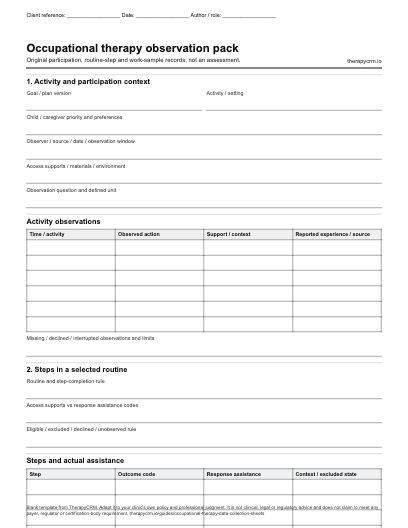
Original participation, routine-step and work-sample records; not an assessment. The blank PDF prints on US Letter paper (3 pages) and the Word document can be edited to match your clinic’s fields. Both are free to download with no sign-up.
Start with a meaningful activity and an observation question
Choose an activity with the child and caregiver, then ask what the record should help the OT understand: which steps were observed, what assistance was used, which environmental barriers appeared, or what changed between comparable work samples. A worksheet should not turn every activity into a test.
- Name the child/caregiver priority and clinician-selected goal version.
- Define the activity, materials, setting, observation window and usual access supports.
- Choose one observation method and write its response/support codes.
- Record observed actions and reported experiences separately.
- Summarize the data with its limits and a question for the next OT review.
Fields for participation, step records and work samples
Describe the activity before interpreting its result. A changed tool, quieter environment or visual sequence can alter what the observation means. “Independent” needs an operational definition that makes clear which access supports remain available.
Swipe or scroll sideways to view all table columns.
| Field | What to record and why |
|---|---|
| Activity and priority | The everyday task and why the child or caregiver selected it. |
| Observation window | Date, location, observer, activity duration and which part was observed. |
| Access and assistance | Equipment/environmental supports and response assistance, kept distinct. |
| Step or work-sample rule | The defined step, observable feature, unit and criteria selected by the OT. |
| Outcome and missing state | Observed action/support, declined or interrupted opportunity, or not observed. |
| Interpretation and review | Raw summary, contextual limits, child/caregiver feedback and OT review question. |
Use a declared denominator for routine steps
A count of independent steps means little unless the reader knows the number of eligible observed steps and what “independent” meant. Record the outcome and assistance for each step. Keep declined, inaccessible, interrupted and unobserved states visible instead of silently dropping them. A child’s decision to stop is not a failed self-care skill.
If a percentage is appropriate to the chosen measure, state the fraction. Do not average percentages from routines with different numbers of eligible steps as though every observation had equal size. Duration, quality, participation preference and work-sample features need their own units; they are not interchangeable measures. No eligible observations means “not calculated”.
Fictional completed pediatric OT observation
Client B and caregiver chose a familiar pack-up routine. The following is an invented record of one observation, not a recommendation for the routine, equipment or assistance.
Swipe or scroll sideways to view all table columns.
| Record field | Fictional completed entry |
|---|---|
| Priority, goal and context | Client B wants to put away chosen drawing materials. Goal O2, plan version 1; familiar table, usual visual sequence available, caregiver nearby; 10 October 2026. |
| Operational rule | Six planned steps. I = observed completion without response assistance while usual access supports remain; A = observed completion with recorded response assistance; D = child declined, described without a failure score. |
| Step sequence | Place paper in folder I; collect pencils A (one spoken reminder); put pencils in case I; close case A (adult helped align lid); return case I; put away remaining materials D. |
| Summary | Five eligible observed steps; three I and two A. I = 3/5 (60%); A = 2/5 (40%). One D remains visible outside the eligible denominator under this written rule. It is not a completed six-step routine. |
| Participation and environment | Four minutes observed. Client chose to stop before the final step. Visual sequence remained available. No conclusion about sensory processing was drawn from this activity. |
| Work-sample record | A separately referenced drawing was saved in the approved record with materials and assistance noted. No legibility, speed or normative score assigned in this observation. |
| Feedback and next review | Caregiver reports pack-up is easier at a quieter table; report labelled as caregiver information. OT to review the activity and assistance definitions on 24 October 2026 before comparing observations. |
Fictional documentation example. Counts illustrate recording rules, not age expectations, diagnosis, mastery or a recommended therapy plan.
Record sensory context, handwriting and everyday planning
A sensory participation entry describes an activity, what was present, the person’s experience where available, observable actions and supports actually used. It does not identify a sensory diagnosis or prescribe a sensory diet. Describe a reported experience as a report rather than inferring discomfort from a count.
For handwriting or another work sample, record the task, source, tool, time boundary and assistance. The OT chooses the features to examine and any licensed instrument. Keep a copy in the approved record instead of reproducing proprietary scoring criteria in a public form.
For planning or daily-routine observations, distinguish knowing a sequence from initiating or organizing the activity under those conditions. Count a defined action, not a presumed executive-function deficit.
Common OT tracking mistakes
Use the worksheet as a transparent record rather than a global score of the child. Retain changes in environment and support so the OT can judge whether comparison is appropriate.
- Calling a custom checklist a standardized assessment.
- Reporting independent completion while omitting adult reminders or hands-on assistance.
- Scoring usual access supports automatically as dependence.
- Treating every declined, painful or unobserved activity as failure.
- Comparing handwriting samples with different materials or timing without a context note.
- Concluding an intervention caused change from a single activity tally.
Move from observation to the OT record
Use fictional or de-identified information in public tools. Keep identifiable records in a practice-approved system, with the permissions, consent process and retention rules applicable to your setting. A client reference can still identify someone within a practice.
Attach the original observation or reference its approved record location. Carry the relevant counts and support conditions into the SOAP note, then let the OT explain what they mean for the selected activity and plan. Review the child’s priorities as well as the numbers.
Professional sources and limits
The workflow, blank forms and fictional examples on this page are original editorial material. The sources below support the professional context; they have not reviewed or endorsed this pack.
The documentation approach is educational material for English-language readers in Canada and the United States. Ontario regulator sources apply to Ontario registrants; ASHA and AOTA resources are professional guidance and do not establish Canadian legal requirements. TherapyCRM serves practices in Canada outside Quebec. It does not submit insurance or government claims.
Primary professional and regulator sources
- [OTSLP-OCC] AOTA: Occupations and everyday activities. Participation in everyday activities provides the professional context for the original observation records; checked 10 October 2026.
- [OTSLP-OUT] AOTA: Intervention outcomes. Professional overview of outcomes and review of occupational performance; checked 10 October 2026. The invented counts below are not outcome instrument scores.
- [OTSLP-COTOASSESS] COTO: Standard for Assessment and Intervention, 2023. Ontario regulator source for assessment, plans and review within the OT’s professional responsibilities; checked 10 October 2026.
- [OTSLP-COTORECORDS] COTO: Standard for Record Keeping, 2023. Ontario OT record-keeping standard; checked 10 October 2026. This original pack is not a regulator form.
Frequently asked questions
What is included in the OT data collection pack?
Three original blank sheets cover participation context, routine steps/support and work-sample/review records. PDF and editable Word versions use the same fields.
Can I use it for sensory observations?
It can record the activity, environment, reported experience, observable actions and supports used. It is not a sensory assessment, scoring protocol or prescription for sensory activities.
How do I record independent steps?
Define independence for that activity, including access supports that remain available. Record response assistance separately and report independent steps over eligible observed steps, with exclusions visible.
Can the form measure handwriting progress?
It can preserve work-sample conditions and clinician-selected observations. It provides no standardized handwriting criteria, test items, age norms or clinical score.
Should a declined activity count as incorrect?
Do not treat withdrawal as proof of a failed skill. Record the choice and context. Write a respectful eligibility rule before observation and explain any exclusion in the summary.
Does this replace an OT evaluation or outcome measure?
No. An OT selects and interprets assessments and outcome measures within their scope. These original records support documentation alongside that process.