For Canadian practices outside Quebec
Disability tax credit form T2201: a worksheet for speech, OT and psychology clinics
The disability tax credit form T2201 has two parts: the family completes Part A and a medical practitioner certifies Part B. A speech-language pathologist can certify speaking, an occupational therapist can certify walking, feeding and dressing, a physiotherapist can certify walking, and a psychologist can certify mental functions. This guide explains what the Canada Revenue Agency asks the clinician to describe, and gives your clinic a worksheet for collecting the information before anyone opens the form.
Fictional example only. Adapt this to your clinic’s own policy and professional judgment. It is not clinical, legal or regulatory advice and does not claim to meet any payer, regulator or certification-body requirement. It is not tax advice. The Canada Revenue Agency decides eligibility, and its pages can change; check them before you rely on this guide.
Last updated: 2026-11-21
By the TherapyCRM team at Data Inn Inc.
Fictional worked example; blank PDF and Word download.
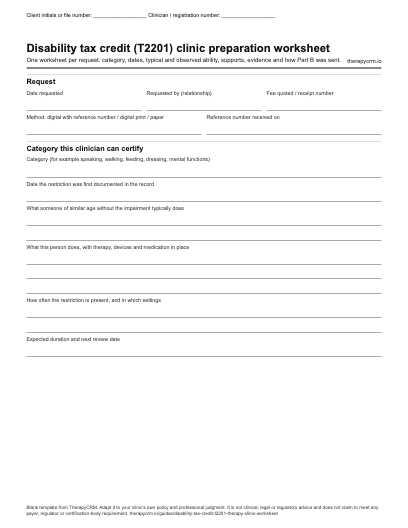
Download a printable T2201 clinic preparation worksheet (PDF or Word)
One worksheet per request: category, dates, typical and observed ability, supports, evidence and how Part B was sent. The blank PDF prints on US Letter paper (2 pages) and the Word document can be edited to match your clinic’s fields. Both are free to download with no sign-up.
What Form T2201 asks a therapy clinician to do
Form T2201 is the Disability Tax Credit Certificate. The Canada Revenue Agency (CRA) uses it to decide whether a person is eligible for the credit.
- Part A is completed by the person with the impairment or their legal representative. For a child, that is usually a parent or guardian.
- Part B is completed by a medical practitioner. Applicants cannot complete Part B themselves.
- The CRA says it bases its decision on the information the practitioner gives in Part B.
- The clinician describes the effects of the impairment. The clinician does not decide eligibility and should not promise a result to the family.
Which practitioner can certify which category
The CRA lists which type of medical practitioner can certify each impairment category. A clinician completes only the sections for categories they are allowed to certify.
Swipe or scroll sideways to view all table columns.
| Practitioner | Categories the practitioner can certify |
|---|---|
| Medical doctor | All impairments |
| Nurse practitioner | All impairments |
| Speech-language pathologist | Speaking |
| Occupational therapist | Walking, feeding and dressing |
| Physiotherapist | Walking |
| Psychologist | Mental functions |
| Audiologist | Hearing |
| Optometrist | Vision |
Source: the CRA’s “How to apply” page, read on November 21, 2026. Behaviour analysts are not on the CRA’s list. A child who needs more than one category certified may need more than one practitioner, or a medical doctor or nurse practitioner.
How the CRA describes a marked restriction
Part B asks about effects, not diagnoses. The CRA’s eligibility page uses these tests, and the worksheet has a line for each.
- Ability: the person cannot do the activity, or it takes three times longer than someone of similar age without the impairment.
- With supports: the restriction remains even with appropriate therapy, medication and devices.
- How often: the restriction is present all or almost all of the time, which the CRA describes as generally at least 90%.
- How long: it has lasted, or is expected to last, for a continuous period of at least 12 months.
- Cumulative effect: two or more significant limitations can count together when their combined effect is equivalent to a marked restriction in one category.
For a child: The comparison is with someone of similar age without the impairment. Write what a child of that age typically does, then what this child does, in plain words.
Gather the information before you open Part B: a fictional example
Most delays come from a clinician opening the form without the dates, examples and supports at hand. Fill in the worksheet from the clinical record first, then complete Part B in one sitting.
The rows below use an invented child and invented observations. They are not wording to copy; they show the level of detail that answers the CRA’s tests.
Swipe or scroll sideways to view all table columns.
| Worksheet line | What the clinician wrote |
|---|---|
| Category and who certifies | Speaking; speech-language pathologist, registration confirmed as current |
| When the restriction began | Observed since first assessment in the fictional record, more than 12 months ago |
| What a child of similar age typically does | Is understood by unfamiliar adults in conversation in a quiet room |
| What this child does, with supports in place | With weekly therapy and a communication device, is understood by unfamiliar adults for single familiar words only |
| How often | In almost all conversations with unfamiliar listeners, at home, school and clinic |
| Evidence in the record | Two assessment reports and the last three progress reports, with dates |
| Expected duration | Expected to continue beyond 12 months; next review date recorded |
Describe what the clinician observed and measured. Do not adjust a description to reach a threshold.
Digital or paper: how Part B reaches the CRA
The CRA accepts a digital application or a paper form. Both parts must be sent by the same method.
- Digital with a reference number: the family completes Part A in their CRA account or by phone and receives a reference number. They give it to the clinician, who completes Part B in the CRA’s digital application for medical practitioners.
- The reference number is valid for up to 12 months and can be used only once. The number, last name and date of birth must match Part A.
- Digital without a reference number: the clinician completes Part B online, prints and signs it, and gives it to the family, who sign Part A and mail the form.
- Paper: the clinician completes only the sections that apply and signs the certification by hand. Part A and Part B are mailed together.
- The CRA says it may contact the clinician’s office to verify the source of the application.
Record on the worksheet which method the family chose and the date the reference number was received, so the clinic does not start a second copy by another route.
Fees, receipts and what to tell the family
The CRA page says that if a medical practitioner charges a fee for completing the application, the applicant is responsible for paying it, and may be able to claim it as a medical expense.
- Decide the clinic’s fee and publish it before the first request, so every family is told the same thing.
- Check your own regulator’s rules on fees for forms and reports before you set one.
- Give a receipt that names the clinician, the registration number, the date and the service as completion of Form T2201.
- Tell the family the clinic describes what it has observed and that the CRA makes the decision.
- Tell the family how long the clinic usually takes, and who to contact if the CRA asks the clinic a question.
Where TherapyCRM fits, and where it does not
TherapyCRM does not complete or submit Form T2201. It keeps the record the clinician reads before completing it. TherapyCRM serves English-language practices in Canada outside Quebec. It is practice management software with a clinical record, not a physician EMR, and has no EMR certification. It has no telehealth or video visits and does not submit insurance or government claims or tax forms.
- Treatment plans, session data and reviewed notes sit in one client record, with dates, so the clinician can find when a restriction was first documented.
- Published progress reports show what was measured over time.
- Staff can create an invoice and a numbered receipt for the clinic’s form fee.
- The clinician still writes Part B in the CRA’s own application or form.
Frequently asked questions
Can a speech-language pathologist sign the disability tax credit form?
Yes, for the Speaking category. The CRA lists speech-language pathologists as medical practitioners who can certify speaking. For other categories the family needs a practitioner the CRA lists for that category, or a medical doctor or nurse practitioner.
Can an occupational therapist complete Form T2201?
Yes, for walking, feeding and dressing. Those are the categories the CRA lists for occupational therapists. An occupational therapist should leave the other sections for a practitioner who is allowed to certify them.
Can a behaviour analyst or ABA clinic certify Form T2201?
Behaviour analysts are not on the CRA’s list of medical practitioners who can certify the form. An ABA clinic can give the family reports and data to share with a listed practitioner, such as a psychologist, a medical doctor or a nurse practitioner.
Does the clinician decide whether a child gets the disability tax credit?
No. The clinician describes the effects of the impairment in Part B. The CRA decides eligibility from that information.
Can a clinic charge a fee to complete the form?
The CRA page says the applicant pays any fee the practitioner charges and may be able to claim it as a medical expense. Check your regulator’s rules on fees for forms, set the fee in advance and give a receipt.
What does “three times longer” mean for a child?
The CRA compares the person with someone of similar age without the impairment. For a child, describe what children of that age typically do and what this child does with therapy, devices and medication in place.
Run a clinic? Ask for a walkthrough of this workflow
Prefer email? support@therapycrm.ioConnect a guide, a resource and a clinic workflow
Read the explanation, try a fictional example, and review the corresponding product workflow. Browser tools and sheets do not send your entries to TherapyCRM.