For Canadian practices outside Quebec
Speech therapy progress report template with parent-friendly wording
A speech therapy progress report template gives a clinic one consistent layout for telling a family where a child’s communication goals stand. The fictional example, blank layout and plain-language swaps below help a speech-language pathologist (SLP) write a report a parent can follow, and the layout can be adapted for a school or funder request.
Fictional example only. Adapt this to your clinic’s own policy and professional judgment. It is not clinical, legal or regulatory advice and does not claim to meet any payer, regulator or certification-body requirement. The example gives no required wording, interval or format.
Last updated: 2026-10-08
Download a printable speech therapy progress report template (PDF or Word)
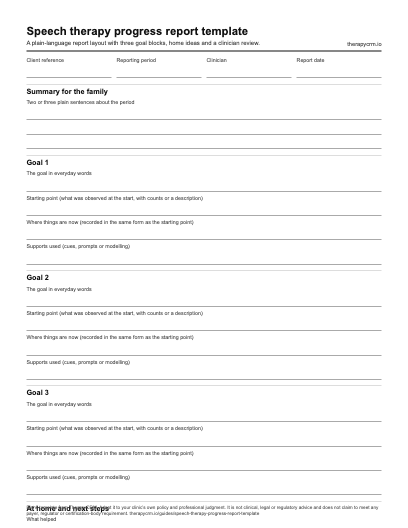
A plain-language report layout with three goal blocks, home ideas and a clinician review. The blank PDF prints on US Letter paper (2 pages) and the Word document can be edited to match your clinic’s fields. Both are free to download with no sign-up.
What a speech therapy progress report covers
A speech therapy progress report summarizes a period of therapy: which goals were worked on, what the clinician observed, which supports helped and what comes next. It looks across a run of sessions, while a SOAP note documents one session.
The clinic decides which fields to include, how often to write the report and who reviews it. A school, funder or insurer may ask for different content or a specific form. Follow what that reader asks for and use this layout as the starting draft.
- The reporting period and who the report is for.
- Each goal worked on, in words the family uses.
- Where the child started and where things stand now, with the counts or observations behind each statement.
- The cues or supports used when the observations were made.
- Ideas the family can try at home.
- The plan for the next period and when it will be reviewed.
Fictional parent-friendly speech therapy progress report example
Client A, the observations and the counts below are invented. The example shows wording and structure. It is not a recommended goal, a typical result or a clinical conclusion.
| Report part | Fictional entry |
|---|---|
| Reporting period | Weeks 1 to 8 of the therapy block |
| Summary for the family | Client A has been using more two-word requests at snack time. Some requests still need a reminder, so we will keep practising in the same routine. |
| Goal | Client A will ask for an item using two words, for example “more crackers”. |
| Where we started | In week 1, Client A used two words in 2 of 10 chances and needed a spoken model each time. |
| Where things are now | In week 8, Client A used two words in 6 of 10 chances: 4 on their own and 2 after a gesture cue. |
| What helped | Keeping the snack in view but out of reach, and pausing for a few seconds before offering a cue. |
| Ideas for home | At snack time, hold the item and wait a moment before helping. Say the two-word request back with a smile. |
| Next steps | Keep this goal for another block, add a second routine such as bath toys, and review again at the next meeting. |
| Review | [Clinician name, reviewed and signed under clinic policy] |
The counts are fictional. Do not read them as a target, a benchmark or an expected rate of progress.
Blank speech therapy progress report template to copy
Copy this layout into the clinic’s document workflow, or use the printable PDF and editable Word file in the download section. Replace every placeholder and remove fields the clinic does not use. Repeat the goal fields once for each goal.
| Field | Fill in for your clinic |
|---|---|
| Client and period | [Client reference, reporting period, clinician and discipline] |
| Summary for the family | [Two or three plain sentences about the period] |
| Goal | [The goal in everyday words, one block per goal] |
| Starting point | [What the clinician observed at the start, with counts or a description] |
| Where things are now | [Latest observation, recorded in the same form as the starting point] |
| Supports used | [Cues, prompts or modelling used when the observation was made] |
| What helped | [Strategies or routines that seemed to help] |
| Ideas for home | [One or two things the family can try in their own routines] |
| Next steps | [Plan for the next period and the review point] |
| Review | [Reviewer, decision and sign-off under clinic policy] |
Plain-language wording families can follow
Parents read the report to learn what has changed and what to do next. Replace clinical shorthand with the words the family already uses, and keep the clinical term in the record if the clinic wants it there.
Give a count with its denominator, such as 6 of 10 chances, rather than a bare percentage. Say which cue was used, and avoid comparing the child with other children or with age expectations unless the clinician is documenting a formal assessment.
| Clinical phrase | Plainer wording |
|---|---|
| Expressive language target | The words and sentences your child uses to tell us things |
| Receptive language | How well your child understands what we say |
| Independent production | Said on their own, without help |
| Gestural prompt | A small hand cue to remind your child what to do |
| Generalization | Using the skill with other people and in other places |
| Baseline | Where we started |
| Fading cues | Gradually giving less help |
These swaps are style suggestions. The clinician chooses language that fits the family and the clinic’s policy.
Progress report, SOAP note and progress note: how they differ
A SOAP note records one session in Subjective, Objective, Assessment and Plan. A progress note may summarize a few sessions for the file. A progress report is usually written for a reader outside the session, such as a parent, so it explains the period in plain words and points to next steps. The same observations can feed all three, but each has its own reader.
The pediatric SLP and OT SOAP note guide shows session-level wording, and the speech therapy goal bank offers goal wording to adapt before you write the goal section of a report.
Sharing the report with a family
Decide before writing who will receive the report and by what route: a meeting, a printed copy, a secure message or a portal document. Send it only to the people the clinic has consent to share with, and check the clinic’s own privacy procedure before sending it to a school or another provider.
In TherapyCRM, invited guardians who use the family portal or the Family app for iPhone and iPad can see progress summaries and charts for the goals a practice chooses to share. That is a goal view, not a written report. The report on this page is a document the clinician writes and reviews. TherapyCRM serves English-language practices in Canada outside Quebec.
Adapt the report to your clinic
Have the supervising SLP review the wording before use, check the clinic’s documentation policy and the expectations of your college, and keep a record of which version was sent to which family. The example contains no required wording, interval or format, and nothing on this page is clinical advice.
Frequently asked questions
What should a speech therapy progress report include?
A clinic may include the reporting period, the goals worked on, where the child started, where things stand now, the supports used, ideas for home and the plan for the next period. The clinician and the clinic decide the final fields.
How do I write a speech therapy progress report parents can understand?
Use everyday words, give counts with their denominators, name the cue or support used and end with one or two next steps. The plain-language table above pairs common clinical phrases with plainer wording.
How often should a speech therapy progress report be written?
This page states no required interval. The clinic’s policy, the family’s needs and any funder or school request set the timing, so check what each reader asks for.
Is a progress report the same as a SOAP note?
No. A SOAP note records one session. A progress report looks across a period and is usually written for a reader outside the session, such as a parent.
Can an occupational therapist or physiotherapist use this template?
The fields are general: goal, starting point, current observation, supports and next steps. A clinic can adapt them for another discipline, although the wording examples are written for speech therapy.
Can I download a blank speech therapy progress report template?
Yes. The PDF prints on US Letter paper and the Word document can be edited to match the clinic’s fields. Both are free to download with no sign-up and contain no client data.
What can families see in TherapyCRM?
Invited guardians can see progress summaries and charts for the goals a practice chooses to share, in the family portal and the Family app for iPhone and iPad. A written report like the one on this page is prepared by the clinician.