For Canadian practices outside Quebec
Speech therapy data collection sheets and recording rules
A useful SLP data sheet preserves what happened, which opportunities were observed and what support was available. This original three-page pack brings an individual trial log, a sample/context log and a review summary together. It works beside a clinician-selected goal; it does not supply test items, diagnose a communication disorder or decide when a goal is mastered.
Fictional example only. Adapt every record to your clinic’s own policy and professional judgment. This is not clinical, legal or regulatory advice and does not claim to meet any payer, regulator or certification-body requirement. The original forms are documentation aids, not assessments, norms or treatment recommendations.
Last updated: 2026-10-10
Download a printable SLP data collection pack (PDF or Word)
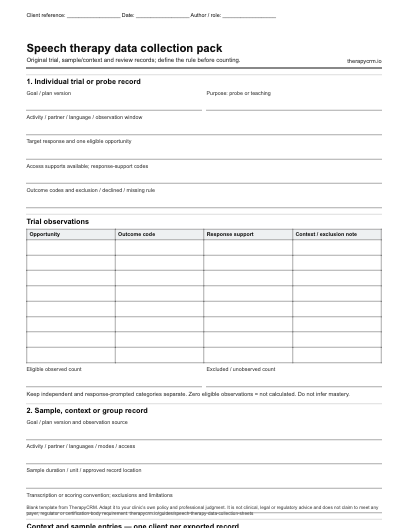
Original trial, sample/context and review records; define the rule before counting. The blank PDF prints on US Letter paper (3 pages) and the Word document can be edited to match your clinic’s fields. Both are free to download with no sign-up.
Choose the sheet before the activity
Select a trial sheet for a defined response to repeated opportunities, a sample log for communication within a recorded context, or a separate client sheet for each participant in a group. A teaching activity and a probe can use the same target but have different support rules. Mark the purpose before collecting data rather than combining them afterwards.
- Write the plan version, target, setting, activity, partner and observation window.
- Define what counts as one opportunity and a target response. Agree a response window if relevant.
- Separate access supports, such as a communication board within reach, from prompts that tell or model the target response.
- Write mutually exclusive response codes and the rule for unobserved, interrupted or declined opportunities.
- Record during the activity, check the tally, then carry a labelled summary into the clinical note.
Field definitions for an individual or group SLP data sheet
The blank pack includes space for the recording rule. Reuse a rule only while the target, context and support conditions remain comparable. Group attendance is not the denominator for an individual goal.
Swipe or scroll sideways to view all table columns.
| Field | What to record and why |
|---|---|
| Goal and version | The exact clinician-selected target and the plan version used that day. |
| Opportunity and eligibility | One defined chance to observe the target; exclusions remain visible with a reason. |
| Result and response support | One outcome code per eligible opportunity, plus the actual prompt or response assistance. |
| Access and context | Communication mode, language/dialect, partner, materials and access supports available. |
| Observation source | Clinician observation, caregiver report or sample review; label the source and date. |
| Summary and next review | Raw numerator/denominator, conditions, missing data and the clinician’s review question. |
Count denominators and support levels separately
For an accuracy measure, divide the count of responses in the named category by eligible observed opportunities, then multiply by 100. Retain both raw counts. Do not add independent and prompted responses and label the result independent accuracy. A prompted response can be useful teaching information without satisfying a goal written for an unprompted response.
Use “not observed” for missing data; use a recorded non-target outcome only when the opportunity was actually observed under the agreed rule. Respect a child’s choice to stop. Define how a declined activity will be documented without treating withdrawal itself as a communication failure. If there are no eligible opportunities, record “not calculated”, not 0%.
Fictional completed SLP data collection example
Client A’s fictional record concerns a clinician-selected message during an agreed activity. The target response may use speech, sign, a picture or a device; the mode is recorded rather than ranked. The clinician decides the target and the observation rule.
Swipe or scroll sideways to view all table columns.
| Record field | Fictional completed entry |
|---|---|
| Session and goal | 10 October 2026; individual play activity; Goal G1, plan version 2; communicate the agreed message within the clinician-defined observation window. |
| Rule and access | One opportunity per defined activity turn. Communication board available throughout. I = target without response prompt; P = target after a model; O = observed other outcome; X = unobserved interruption. |
| Trial sequence | I, P, O, X, I, O, P, I, X, O. Ten planned turns; eight eligible observed turns; two interruptions labelled X. |
| Numerators and denominator | I = 3/8 (37.5%); P = 2/8 (25%); O = 3/8 (37.5%); X = 2, outside the eligible denominator under the written rule. |
| Context and sample entry | Familiar adult, chosen play materials, English used in this observation. No recorded language sample. These counts do not describe other languages or home routines. |
| Group/session handling | Individual observation only. For a group, keep one reference and opportunity tally per client, with no peer’s clinical details on another client’s export. |
| Note and next review | Target responses occurred with and without a model; independent count reported separately. SLP to review whether the activity provides comparable opportunities before the planned review on 24 October 2026. No mastery decision from this one entry. |
Fictional documentation example. Counts illustrate recording rules, not age expectations, diagnosis, mastery or a recommended therapy plan.
Add language samples, articulation probes and AAC observations
For an articulation probe, name the target unit—sound, word or another clinician-defined unit—and retain the number of eligible units. Do not mix a count of sounds with a denominator of words. Use original clinician-selected materials; licensed assessment items belong in their authorized system.
For a language sample, record language, partner, activity, duration, sample location, transcription/scoring convention and excluded or unintelligible segments. If the clinician calculates mean length of utterance, state whether it is in words or morphemes and define utterance boundaries. The speech-sample calculator linked below performs its stated sound/intelligibility arithmetic; it does not calculate MLU or provide norms.
For AAC and pragmatic-language observations, record accessible communication modes, message purpose and partner response. A count of turns alone does not show whether the conversation was useful or wanted by the child.
Common SLP data collection mistakes
Inspect the sheet before using its summary in a progress report. Correct a recording error through the practice’s amendment process rather than silently rewriting the original record.
- Reporting a percentage without its count and denominator.
- Changing materials, response timing or support conditions without a note.
- Counting a repeated prompt as a new opportunity without a predefined rule.
- Treating missed visits, blank cells or unavailable communication access as an incorrect response.
- Pooling caregiver recollection, clinician observation and different-language samples into one accuracy score.
- Putting several clients’ identifiable rows into a file shared with one family.
Review the sheet alongside notes and reports
Use fictional or de-identified information in public tools. Keep identifiable records in a practice-approved system, with the permissions, consent process and retention rules applicable to your setting. A client reference can still identify someone within a practice.
Use the original tally as supporting evidence, then write the clinical interpretation in the note. A progress report can compare like-for-like windows and explain changes in opportunity count, support or setting. The arithmetic is a description of the observed data, not proof of treatment effect.
Professional sources and limits
The workflow, blank forms and fictional examples on this page are original editorial material. The sources below support the professional context; they have not reviewed or endorsed this pack.
The documentation approach is educational material for English-language readers in Canada and the United States. Ontario regulator sources apply to Ontario registrants; ASHA and AOTA resources are professional guidance and do not establish Canadian legal requirements. TherapyCRM serves practices in Canada outside Quebec. It does not submit insurance or government claims.
Primary professional and regulator sources
- [OTSLP-ASSESS] ASHA: Assessment Tools, Techniques, and Data Sources. Professional overview of observation, samples and other assessment information; checked 10 October 2026. The forms here are original and do not reproduce tests.
- [OTSLP-LANG] ASHA: Multilingual Service Delivery. Language history, interpreter collaboration and limits on cross-language score interpretation; checked 10 October 2026.
- [OTSLP-DOC] ASHA: Documentation in Health Care. Distinguishes clinical documentation types and setting-specific requirements. A US professional resource, not a universal reporting schedule; checked 10 October 2026.
- [OTSLP-CASLPO] CASLPO: Records. Ontario regulator’s records resources for audiologists and SLPs; checked 10 October 2026. Read the applicable requirements before clinical use.
Frequently asked questions
Are these speech therapy data sheets free?
The original blank PDF and editable Word pack are free to download without signing up. Adapt the recording rules before clinical use.
What is the difference between a probe and teaching data?
A probe records performance under its defined assessment conditions. Teaching data records practice that may include modelling or other help. Label the purpose and support rules; do not combine the two as independent performance.
How do I calculate speech therapy accuracy?
Divide the count of the named outcome by eligible observed opportunities and multiply by 100. Report the fraction and support condition too. If the eligible denominator is zero, leave the percentage uncalculated.
Can I use the pack for group speech therapy?
Yes, with a separate client reference and denominator for each participant. Group attendance or total group turns cannot substitute for that client’s observed opportunities. Review each export for other clients’ information.
Does the speech sample tool calculate MLU?
No. The linked tool provides its stated speech-sample calculations. The blank sample log can document clinician-selected transcription and MLU conventions, but neither the pack nor that tool supplies MLU norms.
Does a high percentage mean a goal is mastered?
No. A clinician reviews the plan’s criteria, comparable observations, support, context and functional relevance. One percentage or one session cannot make that decision.