For Canadian practices outside Quebec
Interdisciplinary team meeting notes template with a multidisciplinary treatment plan summary
An interdisciplinary team meeting notes template helps a pediatric clinic record what each discipline reported, what the team decided and who does what next. Download the blank note and the shared plan summary as a PDF or Word document, then use the fictional case-conference note below as a model. The template summarizes the plans for one meeting; it does not replace each clinician’s own treatment plan.
Fictional example only. Adapt this to your clinic’s own policy and professional judgment. It is not clinical, legal or regulatory advice and does not claim to meet any payer, regulator or certification-body requirement. The goals, strategies and observations are invented and are not recommended targets.
Last updated: 2026-10-08
Download a printable interdisciplinary team meeting notes template (PDF or Word)
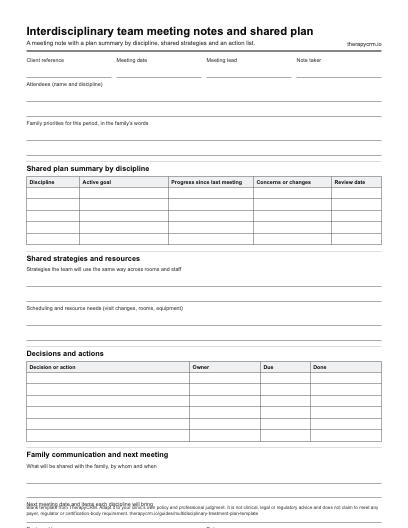
A meeting note with a plan summary by discipline, shared strategies and an action list. The blank PDF prints on US Letter paper (2 pages) and the Word document can be edited to match your clinic’s fields. Both are free to download with no sign-up.
What interdisciplinary team meeting notes should capture
When a child sees an ABA clinician, a speech-language pathologist and an occupational therapist, each discipline keeps its own plan and notes. A team meeting is where those separate plans meet. Good notes show what each discipline reported, which strategies the team will share across settings, what was decided, who owns each action and when the team will meet again.
Meetings are short and busy, so a one-page structure that is filled in during the meeting is easier to keep up than minutes written afterwards.
- Who attended, with their discipline
- What the family has asked the team to work on
- What each discipline reported since the last meeting
- Strategies the team will use the same way across rooms and staff
- Decisions, owners and due dates
- What will be shared with the family, by whom and when
Interdisciplinary team meeting notes template fields
Copy these rows into the clinic’s own document, or use the blank PDF or Word note. The right-hand column shows who usually completes each part.
| Section | What to record | Who completes it |
|---|---|---|
| Header | Client reference, meeting date, meeting lead, note taker, and attendees with their discipline | Note taker |
| Family priorities | The goals or concerns the family asked the team to address, in the family’s words | Meeting lead |
| Discipline updates | For each discipline: active goals, progress since the last meeting, and concerns or changes | Each clinician |
| Shared strategies | Approaches the team will use the same way across rooms, settings and staff | The team together |
| Scheduling and resources | Visit changes, room or equipment needs, and overlaps between disciplines | Coordinator |
| Decisions and actions | What was decided, who owns it and the due date | Meeting lead |
| Family communication | What will be shared with the family, by whom and when | Meeting lead |
| Next meeting | The date and the items each discipline will bring | Note taker |
Multidisciplinary treatment plan template: shared summary by discipline
A shared plan summary puts each discipline’s active goal and the strategy the team will share on one page. It sits beside each clinician’s own treatment plan and does not replace them. Each clinician reviews and amends their own plan under the clinic’s review policy. The fictional summary below is for Client A.
| Discipline | Active goal | Strategy to share | Review date |
|---|---|---|---|
| ABA | Ask for a break using a picture card | Use the same card and the same word in every room | [date] |
| Speech-language pathology | Combine two words to request an item | Model the two-word phrase during play and snack time | [date] |
| Occupational therapy | Complete a hand-washing routine with a visual schedule | Post the same visual schedule at the sink in every room | [date] |
| Other discipline | [goal] | [strategy] | [date] |
The goals and strategies are invented for illustration. They are not clinical advice and not recommended targets.
Fictional case-conference note for Client A
The note below uses the template fields. Everything in it is invented. A real note records what the team actually discussed and decided, and each clinician records their own clinical reasoning in their own documentation.
| Section | Fictional entry |
|---|---|
| Attendees | ABA supervisor, speech-language pathologist, occupational therapist and intake coordinator. The parent joined for the last ten minutes. |
| Family priorities | The parent wants Client A to ask for help instead of leaving the table. |
| Discipline updates | ABA: uses the break card with a gesture prompt on most trials. Speech: says single words and is beginning to combine two. OT: completes the sink routine when the visual schedule is in view. |
| Shared strategy | All three disciplines will use the same break card and the same word for a break. |
| Scheduling and resources | Speech and OT visits could run back to back on one day to reduce travel. The coordinator checks that the shared room is free. |
| Decisions and actions | The ABA supervisor shares the break card image with the other clinicians by [date]. The coordinator asks the family whether back-to-back visits work. Speech reports on the two-word goal at the next meeting. |
| Family communication | The ABA supervisor tells the parent about the shared card at the next visit. |
| Next meeting | [date], with progress on the shared card. |
Run the meeting and share the outcome
A few habits keep the meeting short and the notes useful. Which team members see which information, and what is shared with the family or with outside parties, follows the clinic’s privacy policy and its consent forms.
- Name a meeting lead, a note taker and a timekeeper before the meeting starts.
- Ask each discipline to send its update before the meeting so the meeting time goes to decisions.
- Fill in the note during the meeting, not from memory afterwards.
- Read the decisions and actions aloud before the meeting ends.
- File the note in the clinic’s own record process and tell each owner their action.
- Decide what the family receives and who contacts them.
Where shared-record features help a team
TherapyCRM keeps versioned treatment plans, goals, session data and reviewed SOAP-style notes for each discipline on one client record, so a team can find each discipline’s current plan and recent notes before a meeting. Scheduling checks staff, rooms and equipment across branches, which helps when a meeting decision moves visits. The family portal shows invited guardians only what the practice chooses to share.
Clinicians still review their own plans and session documentation, and the shared record does not make clinical decisions for the team. Use whichever process the clinic already has for the meeting note itself.
TherapyCRM serves English-language practices in Canada outside Quebec. It is practice management software with a clinical record, not a physician EMR, and has no EMR certification. It has no telehealth or video visits and does not submit insurance or government claims, including Ontario Autism Program claims.
Update each plan and its review date after the meeting
When a meeting changes a goal or a strategy, the discipline that owns the plan amends it and records the new version and review date. The meeting note records the decision, and the plan holds the detail. Keeping the two linked makes it easy to see later why a plan changed.
Frequently asked questions
What should interdisciplinary team meeting notes include?
They should show who attended, what the family asked the team to work on, what each discipline reported, the strategies the team will share, the decisions with owners and due dates, what the family will be told and when the team will meet again. The template has a section for each.
What is the difference between multidisciplinary and interdisciplinary?
In common usage, a multidisciplinary team has each discipline work from its own plan and share findings, while an interdisciplinary team plans together toward shared goals. Clinics use the terms loosely, so this template works for either.
Who should attend a team meeting?
The clinicians who treat the child, a coordinator who handles scheduling, and the family when the clinic’s practice includes them. The clinic decides who attends and what the family sees.
Does the meeting note replace each clinician’s treatment plan?
No. The note and the shared plan summary record one meeting. Each clinician keeps and amends their own plan under the clinic’s review policy.
How often should the team meet?
This page recommends no frequency. Choose a rhythm the team can keep, and record the next meeting date on every note.
Should the family see the meeting notes?
That is a decision for the clinic’s privacy policy and consent forms. In TherapyCRM, the family portal shows invited guardians only what the practice chooses to share.
What shared-record features does TherapyCRM have for a team?
It keeps versioned treatment plans, goals, session data and reviewed SOAP-style notes for each discipline on one client record, and it checks staff, room and equipment availability when scheduling. Clinicians still review their own plans and notes.
Can a single-discipline clinic use this template?
Yes. Remove the discipline rows that do not apply and keep the family priorities, decisions and actions sections for case reviews with other staff such as technicians and supervisors.