For Canadian practices outside Quebec
Privacy breach log template for Ontario therapy clinics
A privacy breach log gives an Ontario therapy clinic one place to record every theft, loss or unauthorized use or disclosure of personal health information. Under PHIPA a health information custodian notifies the affected person at the first reasonable opportunity, reports certain breaches to the Information and Privacy Commissioner of Ontario (IPC), and sends the IPC annual counts by March 1. A log kept through the year makes all three possible. This guide summarizes the rules from the statute and gives you a printable log.
Fictional example only. Adapt this to your clinic’s own policy and professional judgment. It is not clinical, legal or regulatory advice and does not claim to meet any payer, regulator or certification-body requirement. It summarizes Ontario’s Personal Health Information Protection Act, 2004 and O. Reg. 329/04 as read on November 21, 2026; check the current law and the IPC’s guidance, and ask your privacy adviser whether your clinic is a health information custodian.
Last updated: 2026-11-21
By the TherapyCRM team at Data Inn Inc.
Fictional worked example; blank PDF and Word download.
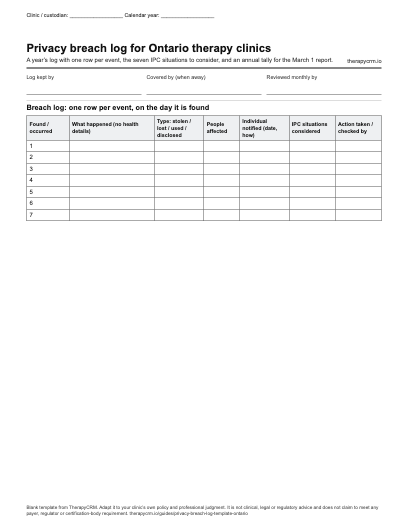
Download a printable privacy breach log (PDF or Word)
A year’s log with one row per event, the seven IPC situations to consider, and an annual tally for the March 1 report. The blank PDF prints on US Letter paper (2 pages) and the Word document can be edited to match your clinic’s fields. Both are free to download with no sign-up.
What PHIPA requires after a privacy breach
Section 12 of PHIPA covers personal health information in a custodian’s custody or control that is stolen, lost, or used or disclosed without authority.
- Notify the individual at the first reasonable opportunity.
- Include in the notice a statement that the individual is entitled to make a complaint to the Commissioner.
- Notify the Commissioner as well when the circumstances meet the requirements set out in the regulation.
- The IPC points out that the duty to notify the individual is separate: it applies even when the breach does not have to be reported to the IPC.
A log does not replace any of these steps. It records that each one was considered, who decided, and when.
The seven situations that must be reported to the IPC
Section 6.3 of O. Reg. 329/04 lists the circumstances in which a custodian must notify the Commissioner, at the first reasonable opportunity. More than one can apply to the same breach.
- Use or disclosure without authority by a person who knew, or ought to have known, that they had no authority.
- Stolen information.
- Further use or disclosure without authority after an initial loss or breach, where it has happened or will happen.
- A pattern of similar losses or unauthorized uses or disclosures.
- An event the custodian must report to a regulatory College that relates to a loss or unauthorized use or disclosure.
- An event that would have to be reported to a College if the agent involved were a College member.
- A breach the custodian decides is significant, considering whether the information is sensitive, the volume, the number of individuals and whether more than one custodian or agent was responsible.
Use the log to decide: For every entry, write which of the seven situations were considered and the reason for the answer. A blank column is how a reportable breach gets missed.
The annual statistics report due March 1
Section 6.4 of the regulation requires a custodian to give the Commissioner, on or before March 1 each year, the number of times each of the following happened in the previous calendar year.
Swipe or scroll sideways to view all table columns.
| Count | What it covers |
|---|---|
| Stolen | Personal health information in the custodian’s custody or control was stolen |
| Lost | Personal health information in the custodian’s custody or control was lost |
| Used without authority | For example, a staff member opening a record with no work reason |
| Disclosed without authority | For example, a report sent to the wrong recipient |
| Collected without authority by means of the electronic health record | Applies to custodians that use the provincial electronic health record |
The IPC states that these statistics include breaches that did not meet the threshold for reporting to the IPC when they happened. The report is sent by the electronic means the Commissioner sets. The examples in the second column are ours, not the regulation’s.
What to record for each breach: a fictional log
Record each event on its own row on the day it is found, even when it looks minor. Describe what happened without copying the personal health information itself into the log.
The rows below are invented. They show three common events in a therapy clinic and how the columns were completed.
Swipe or scroll sideways to view all table columns.
| Found / occurred | What happened | Type | People affected | Individual notified | IPC situations considered | Action taken |
|---|---|---|---|---|---|---|
| Found same day | Progress report emailed to another family with a similar surname | Disclosed without authority | 1 client | Yes, by phone then letter, with complaint statement | None of the seven applied; reason recorded | Recipient confirmed deletion; second-person check added for emailed reports |
| Found 3 days later | Paper session notes left in a staff member’s car, which was broken into | Stolen | 4 clients | Yes, by letter, with complaint statement | Stolen information: reported to IPC | Police report filed; paper notes no longer leave the clinic |
| Found in monthly review | Staff member opened the record of a neighbour’s child with no work reason | Used without authority | 1 client | Yes, by letter, with complaint statement | Knowing use without authority: reported to IPC | Access removed pending review; College reporting checked with adviser |
The “Type” column uses the same words as the annual report, so the March 1 counts are a tally of the column.
Review the log each month and before March 1
A log that nobody reads does not find patterns. Give one named person the review.
- Each month: check that every entry has a type, a notification date and a decision on the seven situations.
- Each month: look for a pattern of similar events, which is itself a situation to report.
- Each month: confirm that each action was finished, and who checked.
- In January: tally the Type column for the previous calendar year, including events that were not reported to the IPC when they happened.
- Before March 1: send the annual counts by the method the IPC sets, and file a copy of what was sent with the log.
- After staff changes: confirm who holds the log and who covers when that person is away.
Clinics outside Ontario
This log follows Ontario’s statute. Other provinces have their own health privacy laws, with different thresholds and different regulators, and private-sector clinics in some provinces fall under federal law for breach reporting.
The log’s columns still work as a record of what happened and what was done. Replace the “IPC situations considered” column with your own province’s test, and check the reporting rules before you rely on it.
Where TherapyCRM fits, and where it does not
TherapyCRM does not keep this log for you and does not notify anyone of a breach. It provides controls that reduce some causes and records that help an investigation. TherapyCRM serves English-language practices in Canada outside Quebec. It is practice management software with a clinical record, not a physician EMR, and has no EMR certification. It holds no privacy or security certification, and it does not report privacy breaches to any regulator on a clinic’s behalf.
- The Security page describes role-based access scoped to the practice and branch, so a role sees only what it needs.
- It describes audit trails; ask how your configuration records who opened or changed a record.
- It describes multi-factor authentication and short staff sessions, which limit exposure on a shared screen.
- Deciding whether an event is a breach, notifying the family and reporting to the IPC remain the clinic’s responsibilities.
Frequently asked questions
Does PHIPA require a clinic to keep a privacy breach log?
The regulation requires a custodian to report annual counts of stolen, lost, used without authority and disclosed without authority events to the IPC by March 1. It does not prescribe a log format. A log kept through the year is the practical way to produce those counts and to show how each event was handled.
When must an Ontario clinic report a privacy breach to the IPC?
When at least one of the seven situations in section 6.3 of O. Reg. 329/04 applies, such as stolen information, knowing use or disclosure without authority, a pattern of similar breaches or a breach the custodian decides is significant. The report is made at the first reasonable opportunity.
Do we have to tell the family about a small breach?
Section 12 of PHIPA requires a custodian to notify the individual at the first reasonable opportunity when their personal health information is stolen, lost, or used or disclosed without authority, and to tell them they can complain to the Commissioner. The IPC notes this duty applies even when the breach does not have to be reported to the IPC.
What is the March 1 privacy breach report?
It is the annual statistics report under section 6.4 of O. Reg. 329/04. A custodian gives the IPC the number of times in the previous calendar year that personal health information was stolen, lost, used without authority or disclosed without authority. Breaches that were not reported individually still count.
Is a misdirected email a privacy breach?
If it contained personal health information and went to someone who had no authority to receive it, it is a disclosure without authority. Record it, notify the individual, and decide whether any of the seven situations requires a report to the IPC.
Is our therapy clinic a health information custodian?
That depends on who provides the care and how the clinic is set up, and it is a legal question. Ask your privacy adviser or counsel, and record the answer in your privacy policy before you rely on this log.
Run a clinic? Ask for a walkthrough of this workflow
Prefer email? support@therapycrm.ioConnect a guide, a resource and a clinic workflow
Read the explanation, try a fictional example, and review the corresponding product workflow. Browser tools and sheets do not send your entries to TherapyCRM.