For Canadian practices outside Quebec
Therapy clinic employee onboarding checklist by role, with Ontario titles
A therapy clinic employee onboarding checklist keeps the first weeks consistent for every hire: accounts, orientation, supervision and review. This version is organized by role, uses Ontario job-title wording for regulated and supervised staff, and ends with a 30-day review. It covers the clinic’s own onboarding steps and gives no employment-law advice.
Fictional example only. Adapt this to your clinic’s own policy and professional judgment. It is not clinical, legal or regulatory advice and does not claim to meet any payer, regulator or certification-body requirement. It gives no employment-law advice. Ontario title wording comes from the official pages listed under Official sources, read on 8 October 2026.
Last checked: 2026-10-08
Download a printable therapy clinic onboarding checklist (PDF or Word)
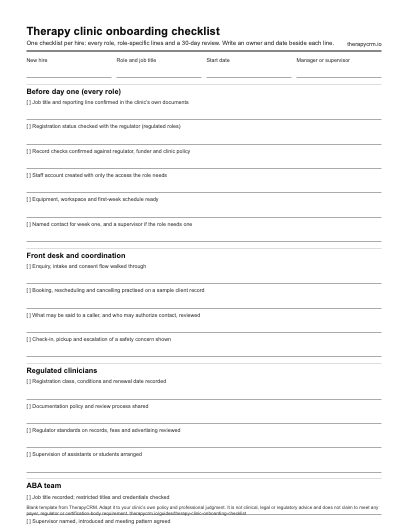
One checklist per hire: every role, role-specific lines and a 30-day review. Write an owner and date beside each line. The blank PDF prints on US Letter paper (2 pages) and the Word document can be edited to match your clinic’s fields. Both are free to download with no sign-up.
How to use a therapy clinic employee onboarding checklist
Copy this therapy clinic onboarding checklist for each new hire, give every line an owner and write the date it was completed. Some lines apply to every role. The role sections add what differs for front-desk, clinical, ABA and billing staff.
This page does not cover employment contracts, pay, hours, leave, probation or termination. Ask an employment lawyer, a payroll provider or the provincial employment standards office about those, and check each regulator’s own rules for its profession.
Before the first day: every role
Finish these lines before the person arrives, so the first day is about people and routines rather than missing accounts.
- Confirm the job title and reporting line in the clinic’s own employment documents.
- For a regulated professional, check registration status with the regulator, using its own public register or contact page.
- Confirm which record checks your regulators, funders and the clinic’s own policy ask for.
- Create the staff account with only the access the role needs, and note who approved it.
- Prepare equipment, a workspace or room booking and a first-week schedule.
- Name one person for questions in the first week, and a supervisor where the role needs one.
- Send the new hire the orientation plan and anything to read before day one.
Job titles and registration: an Ontario example
Ontario reserves several health titles for members of the matching college. Onboarding records, email signatures, name badges and client-facing documents should use the title a person is entitled to use. The table lists the restricted titles in each profession’s Act [R1][R2][R3][R4]. It does not cover every title used in a clinic.
Each of the four Acts also bars non-members from holding themselves out as qualified to practise the profession [R1][R2][R3][R4]. Roles that the table does not list, such as assistants and behaviour technicians, need their own title check with the relevant regulator. For unregistered ABA staff, the CPBAO FAQs give examples of less ambiguous titles [R5].
| Profession | Titles the Act restricts to members | College |
|---|---|---|
| Speech-language pathology | “audiologist”, “speech-language pathologist” and “speech therapist” [R1] | College of Audiologists and Speech-Language Pathologists of Ontario |
| Occupational therapy | “occupational therapist” [R2] | College of Occupational Therapists of Ontario |
| Physiotherapy | “physiotherapist” and “physical therapist” [R3] | College of Physiotherapists of Ontario |
| Psychology | “psychologist” and “psychological associate” [R4] | College of Psychologists and Behaviour Analysts of Ontario |
| Behaviour analysis | “behaviour analyst” [R4] | College of Psychologists and Behaviour Analysts of Ontario |
Each Act restricts the title together with variations and abbreviations. Read the Act or ask the College before using any title that is close to these.
Official sources
- [R1] Audiology and Speech-Language Pathology Act, 1991, S.O. 1991, c. 19 (e-Laws). Section 8, restricted titles; e-Laws currency date 6 October 2026.
- [R2] Occupational Therapy Act, 1991, S.O. 1991, c. 33 (e-Laws). Section 7, restricted title; e-Laws currency date 6 October 2026.
- [R3] Physiotherapy Act, 1991, S.O. 1991, c. 37 (e-Laws). Section 8, restricted titles; e-Laws currency date 6 October 2026.
- [R4] Psychology and Applied Behaviour Analysis Act, 2021, S.O. 2021, c. 27, Sched. 4 (e-Laws). Section 8, restricted titles and holding out; e-Laws currency date 6 October 2026.
- [R5] College of Psychologists and Behaviour Analysts of Ontario, FAQs. Titles and job-title examples for unregulated staff; no page date shown. Read on 8 October 2026.
Front-desk and coordination staff
Front-desk staff meet families first and handle the most privacy-sensitive questions. Walk them through real routines with fictional clients before they handle a live one.
- Walk through how enquiries, intake forms and consent forms move through the clinic.
- Practise booking, rescheduling and cancelling on a fictional client.
- Review what may be said to a caller about a client, and who can authorize contact with a family.
- Show how to check a client in, handle pickup and pass a concern about a child’s safety to the named person right away.
- Explain how invoices, receipts and payment questions are handled and who takes over from the front desk.
Regulated clinicians: speech-language pathologists, occupational therapists and physiotherapists
Regulated clinicians arrive with their own standards, so onboarding is mostly about how the clinic applies them.
- Confirm the registration class, any conditions and the renewal date with the regulator, and decide how the clinic will track renewals.
- Share the clinic’s documentation policy: session notes, progress reports, plan versions and who reviews them.
- Read the regulator’s own standards on records, fees and advertising together, and note where the clinic’s policy goes further.
- Agree caseload, scheduling blocks, room use and shared-equipment booking.
- Set up supervision for any assistants or students the clinician will work with, following the regulator’s supervision standard.
- Walk through the plan templates, goal wording and the progress report layout the clinic uses.
ABA team: behaviour analysts, psychologists and behaviour technicians
The CPBAO FAQs say that the activities of a behaviour analyst are not controlled or restricted acts, so the question for unregistered staff is how they are titled and described. The College also says that it considers the public better protected when behavioural services are provided or directly supervised by regulated professionals [R5].
- Write the behaviour technician’s job title in the clinic’s own records, and avoid the restricted titles and any credential the person is not entitled to show.
- Name the supervisor for each supervisee, introduce them and agree how often they will meet. The supervision log template gives the clinic a record of those meetings.
- Plan how families will be told who supervises their child’s sessions and how to reach that person.
- Train the team member on the clinic’s data collection methods and note writing, with a practice session on a fictional client.
- Confirm which funder rules apply to who may deliver and supervise services for each funded client.
Billing and administration staff
Billing and administration staff handle financial and client records, so access and approvals matter from the first day.
- Explain the clinic’s invoice and receipt process and who approves each step.
- Review what each funder and insurer asks the clinic to record, using the funder’s own guidance.
- Show how payments, refunds and write-offs are approved and who may approve them.
- Describe how privacy requests and complaints are logged and passed to the clinic’s privacy contact.
- Agree who can see financial and client records, and set access to match.
First week and 30-day review
Spread the learning over the first month rather than one long orientation day.
- Day 1: welcome, tour, accounts working, schedule shared and the named contact introduced.
- Week 1: orientation to privacy, safety and incident procedures complete; shadow a colleague; first supervised tasks agreed.
- Weeks 2 and 3: first documentation reviewed with feedback, and any access that does not fit the role corrected.
- Day 30: a review meeting with the manager or supervisor on what is going well, training gaps, access that should change and goals for the next period.
Accounts and access in TherapyCRM
In TherapyCRM, staff accounts carry a role, and access is role-based and scoped to the practice and branch. The practice sets each person’s responsibilities and needs to review access when a role changes or someone leaves. Create the account with the role the person needs on day one, and revisit it at the 30-day review. TherapyCRM serves English-language practices in Canada outside Quebec.
Frequently asked questions
What should a therapy clinic employee onboarding checklist include?
Accounts and access, a named contact, an orientation to privacy and safety procedures, the documentation policy, supervision arrangements where the role needs them, role-specific training and a review at the end of the first month.
Does this checklist give employment-law advice?
No. It covers the clinic’s own onboarding steps. Ask an employment lawyer, a payroll provider or the provincial employment standards office about contracts, pay, hours, leave and termination.
What job titles can unregistered ABA staff use in Ontario?
The Act restricts “behaviour analyst”, “psychologist” and “psychological associate” to College members [R4]. The College gives Supervised Instructor, Supervised Instructor-Therapist, Supervised Therapist and Supervised Interventionist as examples of less ambiguous titles [R5]. Ask the College about any title you plan to use.
Who should check a new clinician’s registration?
The clinic decides who does the check, and the regulator’s own public register or contact page is the place to confirm status. Record who checked and when.
How long should onboarding take?
This page sets no required length. The checklist runs through the first day, the first week and a 30-day review, and a clinic can lengthen it for roles that need supervision.
Does the checklist cover privacy training?
It includes a privacy and safety orientation line for every role but not the content, which depends on your province and your regulators. The compliance pages summarize privacy rules with official sources.
Can I download a blank onboarding checklist?
Yes. The PDF prints on US Letter paper and the Word document can be edited to match the clinic’s roles. Both are free to download with no sign-up and contain no client data.
How does TherapyCRM handle staff access?
Staff accounts carry a role, and access is role-based and scoped to the practice and branch. The practice reviews access when roles change or people leave.