For Canadian practices outside Quebec
Behavior skills training competency checklist: a printable one-skill-per-sheet template
Behavior skills training is easier to defend when the clinic can show what was taught, how many times it was rehearsed and what the trainee had to reach. This competency checklist is a blank, printable sheet for one skill at a time, with the four BST steps (instruction, modeling, rehearsal and feedback), names and initials for trainer and trainee, and a criterion your clinic fills in. It is the blank form that goes with the method guide, followed by a fictional completed example.
Fictional example only. Adapt this to your clinic’s own policy and professional judgment. It is not clinical, legal or regulatory advice and does not claim to meet any payer, regulator or certification-body requirement. Your supervisors’ regulator, your funders and your clinic policy decide who may train, supervise and sign off staff.
Last updated: 2026-10-26
By the TherapyCRM team at Data Inn Inc.
Fictional worked example; blank PDF and Word download.
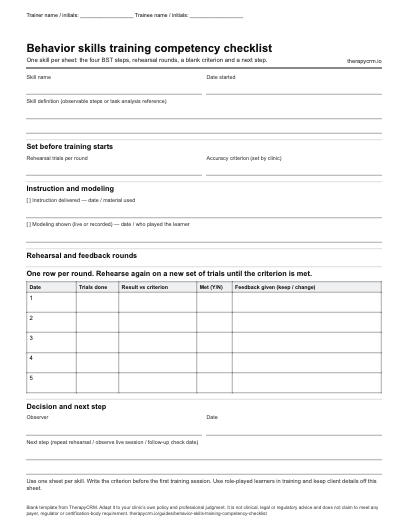
Download a printable behavior skills training competency checklist (PDF or Word)
One skill per sheet: the four BST steps, rehearsal rounds, a blank criterion and a next step. The blank PDF prints on US Letter paper (1 page) and the Word document can be edited to match your clinic’s fields. Both are free to download with no sign-up.
What this competency checklist is for
This page is the blank template. For what each BST component involves and how a clinic can run it, read the method guide; this page does not repeat it. The checklist records one skill per sheet, so that each technician’s file shows, skill by skill, what was taught and what evidence was used to decide they were ready.
Use one sheet for each skill, such as prompt-level data recording, a session-note section or a safety routine. Keep the sheets in the technician’s training file.
What each sheet records
The sheet is one or two pages, depending on how many rehearsal rows your clinic wants to print. It carries these fields.
- Trainer name and initials, and trainee name and initials.
- Skill name and a short written definition, ideally the one-page task analysis the trainee was given.
- Instruction: date delivered and the material used.
- Modeling: date, whether it was live or recorded, and who played the learner.
- Rehearsal: the number of rehearsal trials planned for each round, then a row for each round with the date, the trials completed and the result.
- Feedback: given after each round, with a short note on what to keep and what to change.
- Accuracy criterion: left blank for your clinic to set with the supervising clinician. This page gives no number.
- Observer, date and next step, such as repeat rehearsal, observe in a live session or schedule a follow-up check.
Download and complete the checklist
Fill in the skill definition and the criterion before the first training session, not afterwards. A criterion written in advance turns sign-off into a decision about evidence. The clinic chooses the criterion, the number of trials and who may observe.
Complete one row per rehearsal round. If a round does not meet the criterion, record the feedback given and the next step, then rehearse again on a new set of trials.
A fictional completed example
Everything below is made up. Trainer A trains Trainee B on recording a discrete-trial program on a prompt-level data sheet. The clinic set its criterion before training, so the sheet shows the criterion as entered by the clinic.
Swipe or scroll sideways to view all table columns.
| Field | Entry |
|---|---|
| Trainer / trainee | Trainer A (TA) / Trainee B (TB) |
| Skill definition | Scores each trial with a response and a prompt level using the clinic’s prompt codes, and records no-response when none occurs |
| Instruction | One-page task analysis read and discussed; questions answered |
| Modeling | Trainer A scored a recorded role play aloud |
| Rehearsal trials per round | 10, using a role-played learner |
| Accuracy criterion | Entered by the clinic before training (shown here as “set by clinic”) |
| Round 1 | Prompt codes matched on most trials; one gesture prompt scored as independent. Criterion not met |
| Feedback after round 1 | Praised the matching trials; reviewed the gesture and independent distinction with an example |
| Round 2 | New set of 10 trials; prompt codes matched. Criterion met |
| Observer / date | Trainer A / date of round 2 |
| Next step | Observe Trainee B scoring live trials with Trainer A, then schedule a follow-up check |
Fictional example only. Trainer A and Trainee B are not real people, and the entries show how a sheet reads, not a target.
How to score a rehearsal round
Scoring should be the same for every trainee, so write the rule on the sheet before the first round.
- The trainer scores the same trials separately from the trainee, without comparing until the round ends.
- Compare the two sheets trial by trial and count the agreements against the number of trials in the round.
- Compare the result with the criterion the clinic entered. Record met or not met, not a feeling.
- Give feedback straight after the comparison: name what matched, then explain each mismatch.
- If the criterion is not met, record the next step and rehearse again with a new set of trials, so the trainee is not scoring the same material twice.
Edge cases: drift, new tasks and remote observers
A completed sheet is a record of one decision on one date. These situations need a judgment call and the clinic’s own policy.
Competency drift
A skill signed off months ago may not look the same in daily practice. Add a follow-up check date to the next-step field, and open a fresh sheet for the same skill when a check shows the practice has changed. Keep the earlier sheet; the history is the point.
New tasks
A change to a program, a data sheet or a clinic routine can mean a new skill. Treat it as a new sheet with its own definition and criterion rather than stretching an old sign-off to cover it.
Remote observers
If an observer scores a recorded rehearsal instead of watching in the room, note that on the sheet. Check the clinic’s privacy rules and your funders’ rules before recording anything, and use role-played learners in training recordings rather than clients.
Trade-offs of a one-skill-per-sheet record
One sheet per skill is easy to audit and easy to file, but the paper adds up. A technician with many skills has many sheets, so a clinic may keep an index page on top.
- Set the criterion in advance: it makes sign-off consistent, but it must be revised when the program changes, so date every version.
- More rehearsal trials per round give clearer evidence, and each round takes longer for trainer and trainee.
- Initials keep sheets short, but a printed name field makes the record readable years later.
- Paper is quick on the training room floor; transcribing results into the staff file adds a step for someone to own.
Where the sheet fits with session notes and live data
A signed-off sheet says a trainee met the clinic’s criterion in training. It does not replace review of live work. After sign-off, the trainee records live trials and writes session notes, and a supervisor reviews both.
TherapyCRM does not run training, score competency or decide readiness; supervisors do. TherapyCRM serves English-language practices in Canada outside Quebec.
Frequently asked questions
What is a behavior skills training competency checklist?
It is a record for one skill that shows the four BST steps (instruction, modeling, rehearsal and feedback), the rehearsal results against a written criterion and the decision that followed.
How many rehearsal trials should a sheet use?
This page sets no number. Decide the number of trials per round and the accuracy criterion with your supervising clinician, and write both on the sheet before training starts.
Is it behavior skills training or behaviour skills training?
Both. “Behavior” is the US spelling and “behaviour” the Canadian one. The method is the same.
Why is the accuracy criterion left blank?
Criteria depend on the skill, the funder and the clinic’s own policy. Leaving the field blank keeps the decision with the people responsible for it.
Does one signed sheet mean a technician is competent for good?
No. It records one decision on one date. Add a follow-up check and open a new sheet if practice drifts or the task changes.
Can I use a real client in the rehearsal?
Use role-played or fictional learners in training, and keep client details off the sheet. Check your privacy rules before recording any session.
What file formats are available?
A PDF that prints on US Letter paper and a Word document you can edit. Both are free to download with no sign-up and contain no client data.
Does TherapyCRM run or score BST?
No. Supervisors train and decide readiness. TherapyCRM records session data and notes once staff are working with clients.