For Canadian practices outside Quebec
FBA evidence summary and behaviour support plan documentation
Functional behaviour assessment (FBA) documentation organizes the information a qualified clinician considers. A behaviour support plan record separates the approved support arrangements from observations, hypotheses and review decisions. This original pack is an evidence organizer and review layout, not a functional analysis protocol, diagnostic assessment or treatment prescription.
Fictional example only. Adapt this to your clinic’s own policy and professional judgment. It is not clinical, legal or regulatory advice and does not claim to meet any payer, regulator or certification-body requirement.
Last checked: 2026-10-10
Download a printable fBA evidence and support review (PDF or Word)
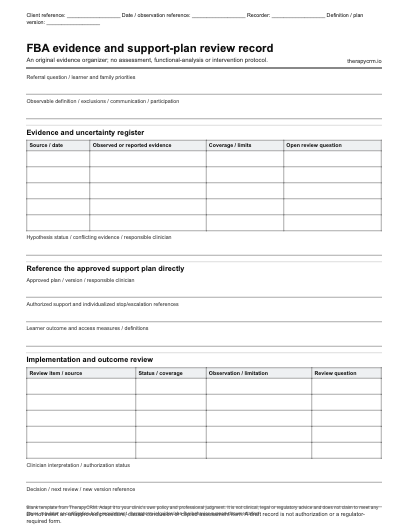
An original evidence organizer; no assessment, functional-analysis or intervention protocol. The blank PDF prints on US Letter paper (2 pages) and the Word document can be edited to match your clinic’s fields. Both are free to download with no sign-up.
Separate the observation, hypothesis and approved plan
A useful evidence summary states the observation method, operational definition, sources, contexts and limitations. IRIS distinguishes observation and implementation-monitoring methods [MEA1] [BSP1]. Descriptive ABC records show sequences, not proof that a particular consequence maintains a behaviour.
The clinician evaluates competing explanations, relevant access or health concerns, competence and consent before choosing assessment or support procedures. Ontario CPBAO standards address competence, consent, records and assessment [ONT1]; they do not turn this worksheet into an Ontario-required FBA form or apply automatically across Canada.
Build the evidence summary and review record
Use the first page to preserve evidence provenance and uncertainty; use the second to reference the clinician-approved plan and its review. Refer to licensed instruments by authorized name and version when relevant without copying their items or scoring keys.
- Record the referral question and the learner’s and family’s priorities in context.
- Write the observable definition, examples, exclusions, current communication and participation arrangements.
- List each information source with its date, reporting person or method, observation coverage and limits.
- Keep direct observations, interviews and hypotheses in separate fields. Record conflicting evidence and questions that remain open.
- Reference only the clinician-approved support plan, version, responsible roles and individualized stop or escalation arrangements; leave unapproved procedures blank.
- Review implementation, opportunities, learner outcomes and access separately; document the clinician’s decision and the next plan version where applicable.
Completed fictional FBA evidence summary
The invented referral question asks what context surrounds Client K pushing drawing materials away. Definition PUSH1 records an observable push moving the tray away; it excludes repositioning materials to draw. The client can request help or stop using speech or the agreed symbol. No assessment conclusion is supplied.
Swipe or scroll sideways to view all table columns.
| Source | Evidence recorded | Coverage/limit | Review question |
|---|---|---|---|
| Direct ABC observation A | Tray presented; client pushed it away; staff paused and asked about activity choice | One observed sequence during 10 minutes | Was the activity or material arrangement accessible and chosen? |
| Direct event observation B | Two defined pushes in 20 observed minutes | Single setting; no within-event timing | Would context-linked observations clarify the pattern? |
| Caregiver interview | Caregiver reports materials are sometimes pushed away at home | Reported information; frequency and context unknown | What does the family want clarified or supported? |
| Learner communication | Client selected another drawing material and said “stop” once | Direct observation; no function inferred | How are preferences and pause requests being respected? |
| Hypothesis field | Not yet established | Descriptive evidence insufficient for a causal claim | Qualified clinician reviews competing explanations |
Completed fictional behaviour support review record
The following invented summary references plan SUPPORT1 as an already approved record. It does not supply treatment steps or assert that the plan is suitable. A real record must contain the authorized individualized content and appropriate safety arrangements.
Swipe or scroll sideways to view all table columns.
| Review field | Fictional entry |
|---|---|
| Current authorization | Plan SUPPORT1; responsible clinician reference recorded in practice system |
| Shared priority | Support accessible, chosen drawing participation and understandable help/stop communication |
| Support reference | Staff consult the approved plan directly; no procedure added by this sheet |
| Observation evidence | ABC A and event B retained; communication and coverage recorded separately |
| Implementation review | Two planned review items completed; one not reviewed; no fidelity percentage assigned |
| Open concern | Material access differs across routines; function not established by these records |
| Review decision | Clinician to review access and evidence before authorizing any change |
| Status | Draft review summary; no new intervention or automatic approval |
Common documentation mistakes and questions for review
Avoid writing “attention seeking”, “escape maintained” or another causal label as if it were a directly observed event. Record the action, surrounding events, reporting source and the clinician’s hypothesis status separately. The person’s pain, communication, access, context and wishes may require attention beyond a data sheet.
Do not enter an unreviewed implementation item as completed, an unknown observation as zero, or a planned support as delivered. Document what was actually observed and the current plan reference. Unexpected distress or safety concerns require the clinic’s individualized response and clinical review, not continued observation to fill a grid.
This resource does not teach experimental functional analysis, authorize restrictive procedures or reproduce standardized assessment items. The outcome-resource directory points to publishers and permission routes where an authorized instrument is needed. The clinician determines the appropriate assessment and competence for the individual.
Use the sheet, tools and clinical record together
Use fictional or deidentified information in the public tools. Keep identifiable observations and completed forms in the practice-approved clinical record under the clinic’s access, retention and amendment policies.
A public worksheet helps prepare and inspect a recording format. It does not authorize a treatment, decide mastery, replace consent or turn a draft into a reviewed clinical record. A clinician should confirm definitions, denominators and interpretation before the team uses the form.
TherapyCRM serves English-language practices in Canada outside Quebec. It is practice management software with a clinical record, not a physician EMR, and has no EMR certification. It has no telehealth or video visits and does not submit insurance or government claims, including Ontario Autism Program claims.
Sources and scope of this original resource
The blank record and every worked entry are original TherapyCRM examples. Sources explain the professional topic; they do not endorse this template. School resources and research studies require interpretation by a qualified clinician for a real clinic. No standardized assessment, publisher form or licensed guideline is reproduced.
Source references
- [MEA1] IRIS: Measuring Behavior. Educational discussion of operational definitions, observation methods, scatterplot recording and graphing. Checked 10 October 2026; school examples do not establish Canadian clinic requirements.
- [BSP1] IRIS: Implementation and Progress Monitoring. School-context explanation of implementation fidelity and progress monitoring. Checked 10 October 2026. It does not set clinic observation schedules or treatment requirements.
- [ONT1] CPBAO: Standards of Professional Conduct. Ontario standards in force 1 July 2024, with practical applications updated 5 May 2026; checked 10 October 2026. Relevant sections address competence, consent, records and assessment. They apply to Ontario registrants and supervised services, not automatically to every province.
Frequently asked questions
Is this a functional behaviour assessment?
No. It is an original evidence organizer and review layout. A qualified clinician determines and conducts an appropriate assessment within their competence and applicable requirements.
Can ABC data establish behavioural function?
An ABC record describes observable sequences. It can inform assessment but does not by itself establish a causal relation or a treatment decision.
What belongs in an FBA evidence summary?
Record the referral question, definition, direct and reported evidence, coverage, context, conflicting information, hypothesis status and clinician review questions.
Does the pack include a behaviour intervention protocol?
No. Reference the authorized individualized support plan directly. The template does not prescribe experimental, restrictive or safety procedures.
Can it reproduce an assessment’s items?
No. Use the publisher’s authorized materials and permissions. This pack contains original generic fields and fictional entries only.
Does it meet every Canadian regulator’s requirements?
No. Requirements depend on jurisdiction, professional status and service context. The Ontario source is specifically labelled and the template claims no regulator-required format.