For Canadian practices outside Quebec
Types of ABA data collection: a method selection worksheet
The types of ABA data collection each answer a different question, so choosing one is a decision to record, not a default to inherit. This page offers a one-page worksheet for picking a measurement method for a single target behaviour or skill, a comparison of eight common methods, and a fictional completed example. The supervising clinician makes the choice; the worksheet only keeps the reasoning in one place.
Fictional example only. Adapt this to your clinic’s own policy and professional judgment. It is not clinical, legal or regulatory advice and does not claim to meet any payer, regulator or certification-body requirement. The page does not choose a measurement method, an interval length or a threshold for any client; the supervising clinician does.
Last updated: 2026-10-26
By the TherapyCRM team at Data Inn Inc.
Fictional worked example; blank PDF and Word download.
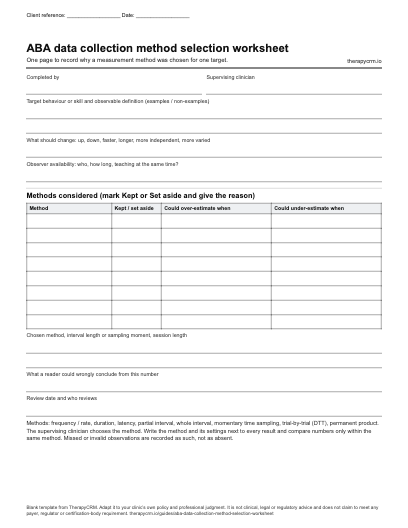
Download a printable data collection method selection worksheet (PDF or Word)
One page to record why a measurement method was chosen for one target. The blank PDF prints on US Letter paper (1 page) and the Word document can be edited to match your clinic’s fields. Both are free to download with no sign-up.
What this worksheet is for, and what it is not
Most clinics already have data sheets. What is often missing is a short written reason why a target is measured the way it is. The worksheet captures that reason for one target at a time, so a new observer, a reviewer or the clinician revisiting the plan can see what was chosen, what it can miss and when it will be looked at again.
It is not a substitute for clinical judgment and it does not recommend a method for any client. Other pages cover neighbouring questions, so this one stays on the decision itself.
- For how a clinic’s sheets are laid out (ABC, frequency, interval), see the ABA data sheets page.
- For scoring partial interval, whole interval and momentary time sampling by hand, see the interval recording scorer.
- For what TherapyCRM Session Runner records, see the ABA data collection feature page.
Types of ABA data collection compared
The table lists eight methods in general terms. Read the last two columns as prompts for discussion, not rules: whether a method over- or under-estimates depends on the behaviour, the setting and how the method is set up.
Swipe or scroll sideways to view all table columns.
| Method | Question it answers | Often considered when | Risk of overestimating | Risk of underestimating |
|---|---|---|---|---|
| Frequency / rate | How many times did it occur, and how many per unit of time? | The behaviour has a clear start and end and is easy to count | Counting fragments of one episode as separate events | Missing events when the observer is busy teaching |
| Duration | How long did it last in total or per occurrence? | Length matters more than how often it happens | Timing from a loose start point | Stopping the timer early when the behaviour tapers |
| Latency | How long between a cue and the start of a response? | Speed of starting is the concern | Starting the clock at the wrong cue | Ending the clock before the response truly begins |
| Partial interval | In how many intervals did it occur at any point? | The behaviour is frequent or has no clean start and end | One brief occurrence scores a whole interval | Observer looks away within an interval |
| Whole interval | In how many intervals did it occur throughout? | The goal is sustained behaviour | Rarely, if the definition is strict | Stop-and-start behaviour may seldom be scored |
| Momentary time sampling | Was it occurring at each agreed instant? | Continuous watching is not possible | Behaviour that happens to be present at the sampling moments | Brief behaviour between the moments |
| Trial-by-trial / DTT | What happened on each presented trial, and with what prompt? | A skill is taught in discrete, scored opportunities | Counting prompted responses as independent | Dropping trials that went off script |
| Permanent product | What does the result left behind show? | The behaviour leaves an outcome that can be reviewed later | Crediting a product someone else completed | Products lost, discarded or not reviewed |
General descriptions only. The supervising clinician chooses the method and its settings for each client.
How to fill in the worksheet, column by column
Complete one row per target. If two methods are needed for the same target, use two rows and say why. Write in pencil on the first draft, because the method is often revised once the observer has tried it.
Swipe or scroll sideways to view all table columns.
| Column | What to write | Prompt |
|---|---|---|
| Target and definition | One observable definition with examples and non-examples | Could two observers agree on it without discussing it first? |
| What should change | Up, down, faster, longer, more independent or more varied | Which dimension of the behaviour is the plan meant to move? |
| Observer availability | Who can observe, how long, and whether they are also teaching | Can the observer both teach and record, or is a second person needed? |
| Methods considered | Two or three methods from the table | Why was each one kept or set aside? |
| Risk of over- or under-estimating | The main way each considered method could mislead | What would a reader wrongly conclude from this number? |
| Chosen method and settings | Method, interval length or sampling moment, session length | Would a new observer set it up the same way? |
| Review date | A calendar date written by the clinic | When will the clinician look at whether the method still fits? |
A fictional completed example
Client C and every detail below are invented. The target is leaving the table during seat work, which the fictional clinician has defined as both feet leaving the floor area marked by the chair and not returning within the same activity step.
The row shows how the reasoning reads when it is written down. A different clinician could reasonably choose differently for a different child, which is the point of recording the reasons.
Swipe or scroll sideways to view all table columns.
| Column | Entry |
|---|---|
| Target and definition | Leaving the table: both feet outside the marked chair area, with the activity step still open. Non-example: standing to retrieve a material the instructor requested. |
| What should change | Fewer occasions of leaving the table during a seated work block. |
| Observer availability | One technician who is also teaching; no second observer on most days. |
| Methods considered | Frequency (easy to tally between trials); duration (set aside, since each absence is short); partial interval (set aside, since the technician cannot watch continuously while teaching). |
| Risk of over- or under-estimating | Frequency: a long wander and two quick steps could look alike. Interval: would need constant attention that the technician does not have. |
| Chosen method and settings | Frequency, tallied per ten-minute work block, with a note when one absence is unusually long. |
| Review date | [Date set by the clinic] |
Fictional data and a fictional decision. It is not a recommendation for any real target.
Edge cases and trade-offs to talk through
These come up often enough to be worth raising before the method is locked in.
- A behaviour that is both frequent and long can look very different under frequency and under duration. Name the dimension the plan is trying to change before choosing.
- Counting a rate needs a stated observation length. Ten occurrences in a short block and ten in a long one are not the same finding, so write the length beside every count.
- Interval methods trade precision for practicality. They estimate how much of a session the behaviour covered, not how many times it happened or for how long.
- Latency depends on a stable cue. If the cue changes between sessions, the numbers stop being comparable.
- Trial-by-trial data needs a rule for prompted trials, so independent and prompted responses are not mixed in one percentage.
- Permanent product only works if the product is reliably kept and attributed. Decide who reviews it and where it is stored.
- Changing a method mid-plan breaks the comparison with earlier data. If a change is needed, mark it on the graph and the sheet, and do not compare numbers across methods.
- Agreement between two observers is easier to check for some methods than others. If the clinic checks agreement, consider that when picking.
What to ask when choosing data collection software
If data are collected on a tablet or in an app, the method still comes first. Use these questions to see whether a tool can follow the method the clinician chose rather than the other way round.
- Which of the eight methods can it record natively, and which would stay on paper?
- Does it record the interval length or sampling moment with the data, so a later reader can interpret the number?
- Can a target be linked to a versioned plan, so a method change is visible in the history?
- How does it handle missed or invalid observations, rather than silently scoring them as absent?
- Can a clinician see the raw entries behind a summary, and not only the percentage?
- What happens when the device is offline or the session is interrupted?
- Can paper sheets and app data both be kept under the same clinical record, if a mixed approach is needed?
Where TherapyCRM fits: TherapyCRM Session Runner records trials and prompts against targets in a versioned plan, frequency with a counter lane and duration with a numeric-series lane. Interval scoring needs a separate workflow, such as a paper sheet. TherapyCRM serves English-language practices in Canada outside Quebec.
Frequently asked questions
What are the main types of ABA data collection?
Common methods include frequency or rate, duration, latency, partial interval, whole interval, momentary time sampling, trial-by-trial (discrete trial) data and permanent product. Each answers a different question about the behaviour.
How do I choose between frequency and interval recording?
Frequency fits behaviour with a clear start and end that an observer can count. Interval methods are often considered when behaviour is very frequent or hard to separate into single events. The supervising clinician makes the choice for each client.
Can one target use more than one method?
Yes, if the clinician decides it is useful. Give each method its own row on the worksheet, say why, and do not compare numbers collected under different methods.
How often should a data collection method be reviewed?
This page sets no schedule. Write a review date on the worksheet and follow the supervising clinician’s and the clinic’s own policy.
Does the worksheet tell me which method to use?
No. It helps record the reasoning behind a choice the clinician makes. The page is not clinical advice and does not select a method, an interval length or a threshold for any client.
Where do interval length and sampling moment go?
Write them in the chosen method and settings column. The scoring page explains how partial interval, whole interval and momentary time sampling are counted.
Can I print the worksheet?
Yes. The PDF prints on US Letter paper and the Word document can be edited to match the clinic’s fields. Both are free to download with no sign-up and contain no client data.
Does TherapyCRM choose the data collection method?
No. Clinicians choose the method. Session Runner records trials and prompts against targets, frequency with a counter lane and duration with a numeric-series lane; interval scoring needs a separate workflow such as a paper sheet.