For Canadian practices outside Quebec
Partial interval recording ABA: scoring example and printable sheet
Partial interval recording ABA scores an interval whenever the target behaviour occurs at any point in it. This page explains the method, scores a fictional ten-interval sheet by hand, compares it with whole interval recording and momentary time sampling, and offers a blank interval recording sheet to print or edit.
Fictional example only. Adapt this to your clinic’s own policy and professional judgment. It is not clinical, legal or regulatory advice and does not claim to meet any payer, regulator or certification-body requirement. The page does not choose a method, an interval length or a threshold for any client.
Last updated: 2026-10-08
Download a printable interval recording sheet (PDF or Word)
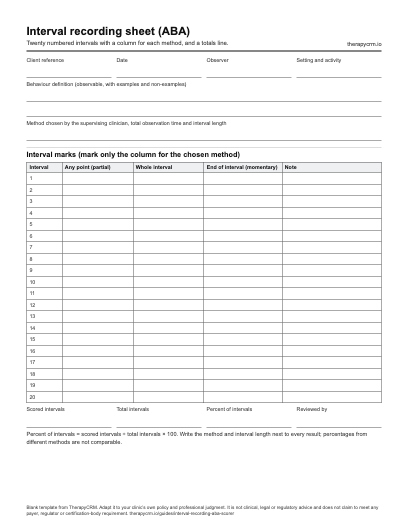
Twenty numbered intervals with a column for each method, and a totals line. The blank PDF prints on US Letter paper (1 page) and the Word document can be edited to match your clinic’s fields. Both are free to download with no sign-up.
What partial interval recording is
Partial interval recording is an observation method. The observer divides an observation period into equal intervals, watches for one defined behaviour and marks each interval in which the behaviour occurred at any point, however briefly. The result is the percentage of intervals that were scored.
Teams often consider interval methods for behaviour that is hard to count one occurrence at a time, such as behaviour that happens often or has no clear start and end. The supervising clinician chooses the method, the interval length and the definition of the behaviour for each client.
Partial interval recording example with fictional data
Client A and the observations below are invented. The fictional target is calling out during circle time, which the supervising clinician has defined as speaking without being called on. The observer watched for five minutes using ten intervals of 30 seconds and marked an interval as scored whenever calling out occurred at any point in it.
Six of the ten intervals were scored, so the partial interval result is 6 ÷ 10 × 100 = 60 percent of intervals. That does not mean calling out lasted 60 percent of the five minutes: one brief call can score a whole 30-second interval.
| Interval | Calling out at any point? | Result |
|---|---|---|
| 1 | Yes | Scored |
| 2 | Yes | Scored |
| 3 | No | Not scored |
| 4 | Yes | Scored |
| 5 | Yes | Scored |
| 6 | No | Not scored |
| 7 | No | Not scored |
| 8 | Yes | Scored |
| 9 | Yes | Scored |
| 10 | No | Not scored |
The observations are fictional and are not a benchmark or a client result.
How to score a partial interval sheet
These steps describe the arithmetic and the paperwork. The supervising clinician decides the method, the interval length and the behaviour definition before anyone observes.
- Write an observable definition of the behaviour, with examples and non-examples, before observing.
- Choose the total observation time and the interval length, and write both on the sheet.
- Use a timer or a recorded cue so every interval has the same length.
- Mark an interval as scored if the behaviour occurs at any point in it. Several occurrences in the same interval still score that interval once.
- Count the scored intervals, divide by the total number of intervals and multiply by 100.
- Write the setting, the activity and the observer on the sheet so a later reader can interpret the percentage.
Partial interval, whole interval and momentary time sampling compared
The same observation can produce different percentages depending on the method, because each method asks a different question. The table describes each method in general terms.
| Method | An interval is scored when | It tends to | Watch for |
|---|---|---|---|
| Partial interval | The behaviour occurs at any point in the interval | Overestimate how much of the time the behaviour occurs | One brief occurrence scores a whole interval |
| Whole interval | The behaviour occurs throughout the entire interval | Underestimate how much of the time the behaviour occurs | A behaviour that stops and starts may rarely be scored |
| Momentary time sampling | The behaviour is occurring at the moment the interval ends, or begins if the team defined it that way before observing | Miss behaviour that happens between the sampling moments | Brief or infrequent behaviour may never coincide with the moment |
The supervising clinician chooses the method and defines the sampling moment for each client.
The same fictional session scored three ways
Suppose a video review recorded, for each of Client A’s ten intervals, whether calling out occurred at any point, throughout the interval and at the moment the interval ended. The totals for the table below are 6 of 10 intervals for partial interval (60 percent), 2 of 10 for whole interval (20 percent) and 3 of 10 for momentary time sampling (30 percent).
The three percentages differ because they answer different questions. Do not compare a partial interval percentage from one sheet with a whole interval percentage from another, and write the method and interval length next to every result.
| Interval | Any point (partial interval) | Whole interval | End of interval (momentary) |
|---|---|---|---|
| 1 | Yes | No | No |
| 2 | Yes | Yes | Yes |
| 3 | No | No | No |
| 4 | Yes | No | No |
| 5 | Yes | No | Yes |
| 6 | No | No | No |
| 7 | No | No | No |
| 8 | Yes | No | No |
| 9 | Yes | Yes | Yes |
| 10 | No | No | No |
Fictional data. An interval can be Yes under whole interval or momentary time sampling only if it is also Yes for any point.
Blank interval recording sheet
The printable sheet has fields for the client reference, observer, setting, behaviour definition and method, then a table of numbered intervals with one column for each method and a place for the totals. Mark only the column for the method the clinician chose.
| Field | Fill in for your clinic |
|---|---|
| Session context | [Client reference, date, observer, setting and activity] |
| Behaviour definition | [Observable definition from the supervising clinician] |
| Method | [Partial interval, whole interval or momentary time sampling] |
| Observation and interval length | [Total minutes and seconds per interval] |
| Interval marks | [One mark per interval for the chosen method] |
| Totals | [Scored intervals, total intervals and percent of intervals] |
| Notes | [Anything that affects how to read the percentage] |
| Review | [Reviewer and decision under clinic policy] |
Paper sheet or software
A paper sheet works without a device, and its total can be summarized in the session note under the clinic’s record policy. TherapyCRM Session Runner records trials and prompts against targets in a versioned plan. Session Runner supports frequency with a counter lane and duration with a numeric-series lane; interval scoring needs a separate workflow, so a clinic that uses interval recording would keep sheets like this one alongside the plan. The ABA data collection page describes what Session Runner does record. TherapyCRM serves English-language practices in Canada outside Quebec.
Frequently asked questions
What is partial interval recording in ABA?
The observer divides an observation period into equal intervals and marks each interval in which the defined behaviour occurred at any point. The result is the percentage of intervals scored.
How do you calculate partial interval recording?
Count the intervals in which the behaviour occurred at any point, divide by the total number of intervals and multiply by 100. In the fictional sheet, 6 ÷ 10 × 100 = 60 percent.
What is the difference between partial interval and whole interval recording?
Partial interval scores an interval if the behaviour occurs at any point in it. Whole interval scores it only if the behaviour occurs throughout the entire interval, so the same session usually gives a lower whole interval percentage.
What is momentary time sampling?
The observer checks whether the behaviour is occurring at the moment each interval ends, or begins if the team defined it that way, and scores only those moments.
Does partial interval recording overestimate behaviour?
It tends to overestimate how much of the time a behaviour occurs, because one brief occurrence scores the whole interval. Report the method and the interval length with the percentage.
How long should each interval be?
This page sets no interval length. The supervising clinician chooses it for the client, the behaviour and the setting.
Can I print an interval recording sheet?
Yes. The PDF prints on US Letter paper and the Word document can be edited to match the clinic’s fields. Both are free to download with no sign-up and contain no client data.
Does TherapyCRM score interval recording?
TherapyCRM Session Runner records trials and prompts against targets. Session Runner supports frequency with a counter lane and duration with a numeric-series lane; interval scoring needs a separate workflow, such as a paper sheet.