For Canadian practices outside Quebec
AAC assessment and device trial documentation record
An AAC record should show communication needs, preferences, access conditions and what was actually observed with each option. This original two-page interview and trial log helps a qualified team preserve that information. It is not a comprehensive AAC assessment, device recommendation, eligibility checklist or funding report. Speech, gesture, sign, pictures and devices can all contribute to communication.
Fictional example only. Adapt every record to your clinic’s own policy and professional judgment. This is not clinical, legal or regulatory advice and does not claim to meet any payer, regulator or certification-body requirement. The original forms are documentation aids, not assessments, norms or treatment recommendations.
Last updated: 2026-10-10
Download a printable AAC interview and trial record (PDF or Word)
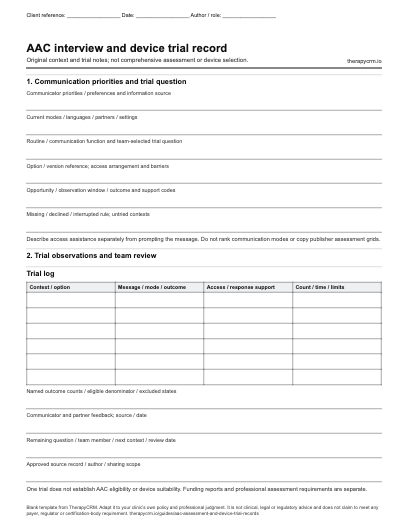
Original context and trial notes; not comprehensive assessment or device selection. The blank PDF prints on US Letter paper (2 pages) and the Word document can be edited to match your clinic’s fields. Both are free to download with no sign-up.
Define the trial question with the communicator and team
Choose a real communication context and a question for the team to explore. Record the communicator’s preferences using accessible methods. An SLP and relevant professionals select assessment methods, access arrangements and trial options; a blank comparison table should not decide those choices.
ASHA describes feature matching around individual needs and contexts. A short trial may leave questions unanswered. Document what has not yet been tried rather than treating a single result as proof that someone cannot use AAC.
- Describe the desired communication function and routine, not only requesting.
- Record current communication modes, partner/context information and preferred languages.
- Name the selected option and access arrangement without assigning a global system score.
- Set the observation window, opportunity rule and response-support codes.
- Record the communicator’s feedback, practical barriers and next team review.
AAC interview and trial log field definitions
Keep access support distinct from prompting the message. A mounted device or a communication partner’s access assistance is not automatically evidence that a message was prompted. Write what the assistance actually involved.
Swipe or scroll sideways to view all table columns.
| Field | What to record and why |
|---|---|
| Communication priority | Chosen routine/function, desired messages and communicator/family preferences. |
| Modes and language context | Current accessible modes, language/dialect, partners and settings. |
| Option and access | Trial option, layout/version reference, positioning/access arrangements and barriers. |
| Opportunity and support rule | Eligible observed communication opportunities and actual response prompting. |
| Observed messages and feedback | Messages/modes used, whether communication was understood, communicator/partner feedback and data source. |
| Decision still to be made | Unanswered question, team member responsible, additional context needed and review date. |
Report opportunities without ranking communication modes
For a chosen opportunity measure, count the named message outcome over eligible observed opportunities and retain the fraction. For a frequency measure, record the observation duration. Do not treat counts collected over different durations as equal.
Record message support, access assistance and partner behaviour. Do not combine independent messages and messages after a response model into an unexplained success percentage. Do not score a request to stop as failure or rank speech above another effective mode. Unavailable access, interrupted observation and a declined activity need their own records and predefined eligibility rules.
Fictional completed AAC trial record
Client E’s invented entry records one trial context. “Option A” is a fictional reference and carries no recommendation for a commercial device or vocabulary layout.
Swipe or scroll sideways to view all table columns.
| Record field | Fictional completed entry |
|---|---|
| Priority and contributors | 10 October 2026; Client E chooses communicating “continue”, “stop” and comments during a favourite activity. Family and fictional SLP discuss current gesture, picture and speech use. |
| Option and access | Option A available beside the activity; usual positioning/access assistance recorded. English used in this trial; other home-language messages require team review. |
| Observation rule | Six planned activity opportunities. One interrupted before it could be observed; five eligible. I = agreed message without response model; M = agreed message after response model; O = other observed outcome. |
| Observed counts | Two I, two M, one O: I = 2/5 (40%); M = 2/5 (40%); O = 1/5 (20%). One interruption recorded outside the eligible denominator. Access assistance was not coded as a response model. |
| Communication and preference | Messages used gesture and the trial option. A “stop” message was acknowledged. Client preference was recorded as an accessible choice; no global modality ranking or mastery decision. |
| Barrier and limits | Short familiar-partner observation; no evidence yet from another routine/partner. Comparison with another option has not taken place. |
| Next review | Team to arrange the agreed additional context observation and review feedback on 24 October 2026. Device selection and funding decisions remain with qualified professionals and the applicable process. |
Fictional documentation example. Counts illustrate recording rules, not age expectations, diagnosis, mastery or a recommended therapy plan.
Use publisher resources without reproducing them
A publisher’s AAC assessment or planning tool has its own scope, instructions and access terms. Link to the original resource rather than copying its grid, criteria or goal bank into a clinic product. A device-funding report has requirements that this pack does not address.
Common AAC recording mistakes
Review the communication context before comparing options. A record of what was available can matter as much as the message count.
- Reducing assessment to requesting preferred items.
- Calling access assistance a response prompt without describing it.
- Treating a brief unfamiliar-system trial as a fixed ability limit.
- Ignoring other effective communication modes or home languages.
- Combining partner reports and clinician counts without labels.
- Presenting a custom worksheet or manufacturer goal resource as payer approval.
Keep the trial record with the clinical team
Use fictional or de-identified information in public tools. Keep identifiable records in a practice-approved system, with the permissions, consent process and retention rules applicable to your setting. A client reference can still identify someone within a practice.
The team reviews the evidence with the communicator and family, documents what was discussed and assigns ownership of the next step. If OT or another professional contributes access observations, record that person’s role and findings rather than translating them into an SLP conclusion.
Professional sources and limits
The workflow, blank forms and fictional examples on this page are original editorial material. The sources below support the professional context; they have not reviewed or endorsed this pack.
The documentation approach is educational material for English-language readers in Canada and the United States. Ontario regulator sources apply to Ontario registrants; ASHA and AOTA resources are professional guidance and do not establish Canadian legal requirements. TherapyCRM serves practices in Canada outside Quebec. It does not submit insurance or government claims.
Primary professional and regulator sources
- [OTSLP-AAC] ASHA: Augmentative and Alternative Communication. Individualized AAC assessment, feature matching and contextual barriers; checked 10 October 2026. It does not endorse this trial record.
- [OTSLP-ASSESS] ASHA: Assessment Tools, Techniques, and Data Sources. Professional overview of observation, samples and other assessment information; checked 10 October 2026. The forms here are original and do not reproduce tests.
- [OTSLP-LANG] ASHA: Multilingual Service Delivery. Language history, interpreter collaboration and limits on cross-language score interpretation; checked 10 October 2026.
Frequently asked questions
Is this a complete AAC assessment?
No. It is an original interview/trial documentation aid. Qualified professionals choose the assessment, access process and interpretation with the communicator and family.
Does it recommend an AAC device?
No. The record preserves observations, preferences, access arrangements and unresolved questions. It has no algorithm for selecting a device.
Is access assistance the same as a prompt?
Not necessarily. Describe whether assistance enabled physical/sensory access or supplied the target message. Write the operational rule and record both conditions.
How should multimodal communication be recorded?
Record the mode or combination used, message purpose, partner/context and supports. Do not automatically rank a spoken message above another effective communication mode.
Does it include the Dynamic AAC Goals Grid?
No. It links to the original publisher’s resource, which has its own instructions and access terms. Its grid and branded goals are not reproduced.
Can I submit this as an AAC funding report?
It makes no funding or payer requirement claim. The responsible professional checks the particular funding program’s current assessment and documentation requirements.