For Canadian practices outside Quebec
Caregiver coaching and home practice documentation
A caregiver record should preserve the conversation: what the family wants to try, what the clinician actually discussed, what the caregiver understood and what happened in the chosen routine. This original three-page pack combines a coaching discussion, an agreed home-practice record and feedback for review. It supplies no exercises, treatment dosage or ready-made strategies.
Fictional example only. Adapt every record to your clinic’s own policy and professional judgment. This is not clinical, legal or regulatory advice and does not claim to meet any payer, regulator or certification-body requirement. The original forms are documentation aids, not assessments, norms or treatment recommendations.
Last updated: 2026-10-10
Download a printable caregiver coaching record (PDF or Word)
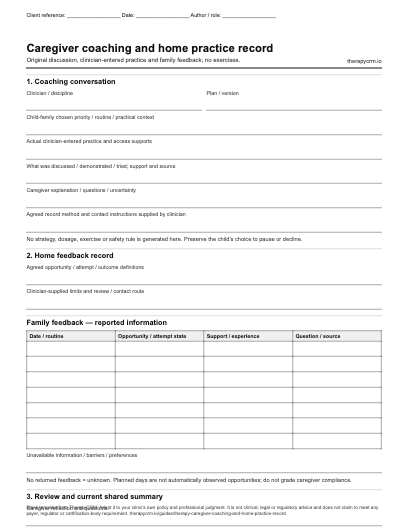
Original discussion, clinician-entered practice and family feedback; no exercises. The blank PDF prints on US Letter paper (3 pages) and the Word document can be edited to match your clinic’s fields. Both are free to download with no sign-up.
Begin with shared priorities and an achievable record
Ask what routine the family wants to discuss and what would make the record useful to them. Respect the child’s preferences, communication and ability to pause or decline. A home plan must be selected by the responsible clinician for that child; the template does not generate one.
ASHA’s early-intervention resource supports family partnership and coaching in everyday routines. The original workflow here is a documentation aid, not a coaching fidelity instrument. Record the discussion and caregiver feedback rather than assigning a compliance grade.
- Identify the selected routine, family priority and clinician responsible.
- Write the actual clinician-taught or agreed practice in clear language.
- Record what was demonstrated, discussed or tried and the support used.
- Invite the caregiver’s explanation/questions; record unresolved uncertainty without blame.
- Agree how feedback will be returned and who will review it.
Coaching and home-practice record field definitions
Separate the clinician’s observation from caregiver recollection. “Not returned”, “not offered”, “declined” and “not observed” describe different states and do not show nonadherence by themselves.
Swipe or scroll sideways to view all table columns.
| Field | What to record and why |
|---|---|
| Shared priority and routine | What the child/family selected, practical context and responsible clinician. |
| Clinician-entered practice | The actual agreed wording, access supports and any clinician-supplied limits or contact instructions. |
| Discussion and practice | What was explained/modelled/tried, by whom, with what assistance and what was observed. |
| Caregiver understanding | Caregiver’s explanation, questions and points still unclear; record rather than judge. |
| Home feedback | Date/source, whether the opportunity arose, participation, supports and child/caregiver experience. |
| Next review and handoff | Who will review, when, how questions will be handled and which plan version applies. |
Distinguish opportunities, attempts and reported feedback
If the plan uses counts, define an offered opportunity, an attempt and the named outcome with the clinician. Planned days are not automatically observed opportunities. Keep source/date and denominator visible. Record actual support and the child’s choice to stop; do not score withdrawal as treatment failure.
A returned checklist can describe the caregiver’s report without establishing treatment effect or mastery. No returned information means unknown, not zero. The clinician reviews burden, accessibility and preferences before deciding whether the practice or record should change.
Fictional completed caregiver coaching record
Client F’s invented record leaves the strategy in a referenced clinician plan rather than prescribing a clinical action to readers. The family’s feedback helps decide what to discuss at review.
Swipe or scroll sideways to view all table columns.
| Record field | Fictional completed entry |
|---|---|
| Priority and plan | 10 October 2026; family selects a familiar play routine. Responsible fictional SLP, plan H1 version 2; OT consulted only on the agreed access arrangement. |
| Clinician-entered practice | Use the practice already taught and recorded in H1 during the family-selected routine. Usual communication access remains available. No new strategy or dosage generated by this form. |
| Discussion and observed practice | Caregiver describes H1 in their own words and tries it once with clinician support. Record identifies the support used; it does not label the caregiver competent from one attempt. |
| Understanding and questions | Caregiver asks what to record when the routine does not arise. Clinician explains the agreed missing-state labels; further questions can be sent through the clinic’s agreed contact route. |
| Home feedback | Five planned routine days: two reported attempts, one reported offered opportunity declined by the child, one day when the routine did not arise, one day with no returned information. These states are not collapsed into “2/5 successful”. |
| Counts and source | Caregiver report, not clinician observation. No response accuracy numerator/denominator was defined, so none is calculated. Access support noted; independent skill is not inferred. |
| Review and sharing | Responsible clinician to review burden, questions and the child’s preference on 24 October 2026. Agreed summary shared through the approved record process; strategy changes require clinician review. |
Fictional documentation example. Counts illustrate recording rules, not age expectations, diagnosis, mastery or a recommended therapy plan.
Use one shared summary with clear discipline responsibility
For SLP and OT input, identify who authored each practice item and who answers questions about it. A shared routine does not make professional scopes interchangeable. The family should have one understandable current summary rather than conflicting instructions copied from old plans.
Record any clinical precautions or escalation/contact instructions only as actually supplied by the clinician. This pack does not invent stop rules, emergency advice, feeding strategies or exercises. A caregiver’s question about safety goes to the appropriate clinician and the applicable local process.
Common home-practice documentation mistakes
A useful record makes the next conversation easier. Remove fields that add burden without answering a clinical question.
- Giving a family a generic therapy exercise before the clinician selects it.
- Calling an unreturned sheet noncompliance.
- Using planned days as the denominator for unobserved skill performance.
- Changing the strategy without identifying the responsible clinician and plan version.
- Recording only repetitions while omitting support, child preference or practical barriers.
- Sharing another client’s example as though it were this child’s plan.
Review feedback and update the current plan
Use fictional or de-identified information in public tools. Keep identifiable records in a practice-approved system, with the permissions, consent process and retention rules applicable to your setting. A client reference can still identify someone within a practice.
At review, confirm what the family wants to continue, what needs clarification and what the clinician actually changes. Preserve the earlier version and record the new agreement. Home feedback should inform professional reasoning alongside other evidence, not trigger automatic clinical changes.
Professional sources and limits
The workflow, blank forms and fictional examples on this page are original editorial material. The sources below support the professional context; they have not reviewed or endorsed this pack.
The documentation approach is educational material for English-language readers in Canada and the United States. Ontario regulator sources apply to Ontario registrants; ASHA and AOTA resources are professional guidance and do not establish Canadian legal requirements. TherapyCRM serves practices in Canada outside Quebec. It does not submit insurance or government claims.
Primary professional and regulator sources
- [OTSLP-COACH] ASHA: Family-Centered Care and Coaching in Early Intervention. Family partnership and coaching within everyday routines; checked 10 October 2026. Publisher forms and reflection prompts are not reproduced.
- [OTSLP-COTOASSESS] COTO: Standard for Assessment and Intervention, 2023. Ontario regulator source for assessment, plans and review within the OT’s professional responsibilities; checked 10 October 2026.
- [OTSLP-CASLPO] CASLPO: Records. Ontario regulator’s records resources for audiologists and SLPs; checked 10 October 2026. Read the applicable requirements before clinical use.
Frequently asked questions
Does this include SLP or OT home exercises?
No. It records the practice selected and taught by the responsible clinician. It does not prescribe a strategy, dosage or exercise.
How is this different from the home-practice planner?
The planner records a clinician-entered plan and tracking states. This pack adds the coaching conversation, caregiver understanding, questions, discipline responsibility and review summary.
What if the family does not return the record?
Record that feedback is unavailable. Do not turn missing information into a zero performance score or an assumption of nonadherence. Discuss practical barriers and preferences at review.
Can SLP and OT use one caregiver record?
Yes, with each item’s author/responsible clinician, current plan version and clear review/contact arrangements. Shared documentation does not transfer clinical responsibility between disciplines.
Should a declined home activity be scored as failure?
Respect the child’s choice and record the context separately. The clinician defines an appropriate observation rule; withdrawal is not automatically failed performance.
Is this a validated caregiver coaching scale?
No. It is an original discussion and documentation record, with no fidelity score, normative criteria or certification claim.