For Canadian practices outside Quebec
Task analysis and chaining data sheet for ABA documentation
A task analysis data sheet lists an activity’s observable steps and records the result and support for each step. Keep the step definition, order and version stable so a daily-living or activity-participation summary still means the same thing at the next review.
Fictional example only. Adapt this to your clinic’s own policy and professional judgment. It is not clinical, legal or regulatory advice and does not claim to meet any payer, regulator or certification-body requirement.
Last checked: 2026-10-10
Download a printable task analysis record (PDF or Word)
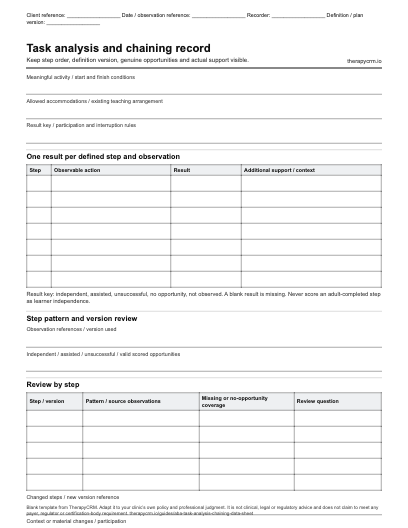
Keep step order, definition version, genuine opportunities and actual support visible. The blank PDF prints on US Letter paper (2 pages) and the Word document can be edited to match your clinic’s fields. Both are free to download with no sign-up.
Task analysis describes steps; chaining describes the teaching arrangement
Task analysis breaks an activity into steps; a step record can show independence and needed support [TA1]. Forward chaining, backward chaining and total-task arrangements describe different ways a clinician may organize teaching [TA2]. The sheet documents the arrangement already selected; it does not choose one or provide a teaching protocol.
Do not score a step completed by an adult as learner independence. A step intentionally outside the learner’s opportunity in a chaining arrangement needs a no-opportunity entry. Keep useful accommodations distinct from additional prompts: an accessible bag or visual reference may be part of the agreed independent condition rather than a failure.
Build and use the step-level blank sheet
Choose an activity meaningful to the learner, then confirm the step list and observation conditions with the clinician. For personal care, feeding or other specialized activities, this generic layout does not establish safety, scope or appropriate procedures.
- Write the activity, start and finish conditions, permitted accommodations and definition version.
- Number observable steps in the agreed order. Include examples and a shared result key.
- State the existing teaching arrangement and which steps will be genuine learner opportunities.
- Record one result per step per observation: independent, assisted, unsuccessful, no opportunity or not observed. Add the actual assistance in a separate field.
- Record interruptions, declined participation or inaccessible materials in context. Do not make a declined activity an independence failure by default.
- Total valid scored opportunities, report coverage separately and review the step pattern before changing the plan.
Completed fictional task analysis: packing a chosen activity bag
Client E chooses to pack a drawing bag. Version BAG1 uses five steps, with the bag open and a visual list available as agreed accommodations. Observation A is a recorded practice opportunity; its support levels are invented, not a recommended prompt sequence.
Swipe or scroll sideways to view all table columns.
| Step | Observable action | Result | Additional support/context |
|---|---|---|---|
| 1 | Put the selected sketchbook in the open bag | Independent | Visual list available; no additional prompt |
| 2 | Put selected pencils in the bag | Assisted | Gestural reminder toward pencils |
| 3 | Put the selected eraser in the bag | Unsuccessful | Opportunity observed; eraser not placed |
| 4 | Close the bag zip | Independent | No additional prompt |
| 5 | Carry the bag to the chosen shelf | No opportunity | Routine ended before carrying was offered |
| Summary | Five defined steps; four scored opportunities | 2 independent / 4 = 50% | One no-opportunity step; no missing rows |
Read step independence and prompt data together
For observation A, the denominator is four observed learner opportunities: two independent, one assisted and one unsuccessful. The fifth step had no opportunity and stays outside this independence calculation. The reported 50% must be accompanied by four-of-five opportunity coverage; it does not mean half the whole routine was independently completed.
If a result is not observed, preserve that state and show how many steps are missing. A result of unsuccessful means a valid opportunity was observed under the agreed scoring rule; it is different from forgetting to record. A completed routine with assistance is also different from an independently completed routine.
For a spreadsheet version, the step-level task tracker provides blank, source and report CSV exports. Import a CSV into Excel or an approved Google Sheets workflow using its header row. Preserve observation references, version, step order, result and support notes. Keep the tool settings and scoring rule with the source record; the PDF and Word pack is not an Excel workbook or a Google Sheets template.
Prompt-fading review needs step-specific data. Pooling every step into one percentage can hide a step that always receives assistance. There is no universal prompt hierarchy, mastery percentage or chaining arrangement supplied by this resource.
Keep changed steps and generalization conditions visible
When a step is split, removed, inserted or reordered, start a new definition version and keep the prior record. In BAG2, opening a closed bag would be a new step and change the denominator. A higher percentage after removing a difficult step does not by itself show improved independence.
Record a different person, place, material or accommodation when checking transfer. Packing the same bag with the same helper is not evidence for every daily-living activity. The clinician chooses meaningful contexts, consent and participation arrangements and the next review decision.
Common mistakes include leaving adult-completed steps blank, treating assisted completion as independent, changing the step list without a version, and averaging percentages with different denominators. Sum comparable source counts or keep contexts separate, and always disclose coverage.
Use the sheet, tools and clinical record together
Use fictional or deidentified information in the public tools. Keep identifiable observations and completed forms in the practice-approved clinical record under the clinic’s access, retention and amendment policies.
A public worksheet helps prepare and inspect a recording format. It does not authorize a treatment, decide mastery, replace consent or turn a draft into a reviewed clinical record. A clinician should confirm definitions, denominators and interpretation before the team uses the form.
TherapyCRM serves English-language practices in Canada outside Quebec. It is practice management software with a clinical record, not a physician EMR, and has no EMR certification. It has no telehealth or video visits and does not submit insurance or government claims, including Ontario Autism Program claims.
Sources and scope of this original resource
The blank record and every worked entry are original TherapyCRM examples. Sources explain the professional topic; they do not endorse this template. School resources and research studies require interpretation by a qualified clinician for a real clinic. No standardized assessment, publisher form or licensed guideline is reproduced.
Source references
- [TA1] Texas SPED Support: Data Collection — Task Analysis. Public education resource explaining step-level support recording. Checked 10 October 2026. The TherapyCRM packing example and blank sheet are original, not a copy of the publisher’s form.
- [TA2] AFIRM: Task Analysis evidence-based practice packet. Background on task analysis and chaining terminology. Linked for qualified professionals to consult directly; its protocols and checklists are not reproduced.
Frequently asked questions
What does a task analysis data sheet record?
It records a stable list of observable steps, the result of each genuine opportunity and any support, interruption or missing observation.
Is a task analysis the same as chaining?
No. The analysis describes the steps; chaining describes the selected teaching arrangement. Record both without allowing a worksheet to choose a clinical procedure.
How do I calculate percent independent steps?
For the example’s rule, divide independent steps by observed scored learner opportunities. Show no-opportunity and missing steps separately, and state the exact denominator.
What if an adult completes one step?
Record whether the learner had a genuine opportunity. If no opportunity was arranged, mark that state; do not score the adult’s action as learner independence.
Can the sheet record activities of daily living?
It can document clinician-defined steps for a meaningful routine. It does not provide toileting, feeding, personal-care or safety treatment instructions.
Do I need a new version when the steps change?
Yes. Retain the old version and start a new one when changing step text, number or order so comparisons retain their context.