For Canadian practices outside Quebec
Generalization and maintenance data sheet with contextual examples
A generalization data sheet records a defined skill across people, places, materials or routines. A maintenance record examines the same question over time with the teaching and support conditions stated. A single high percentage in one context cannot answer both questions.
Fictional example only. Adapt this to your clinic’s own policy and professional judgment. It is not clinical, legal or regulatory advice and does not claim to meet any payer, regulator or certification-body requirement.
Last checked: 2026-10-10
Download a printable generalization and maintenance sheet (PDF or Word)
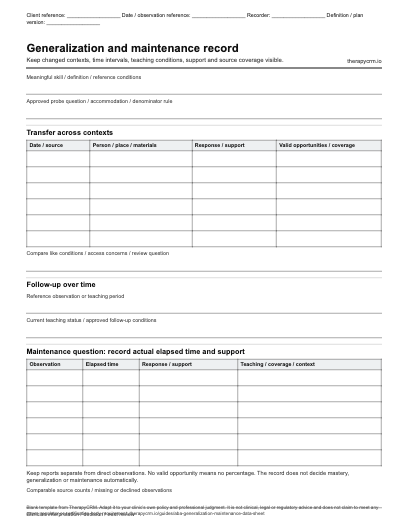
Keep changed contexts, time intervals, teaching conditions, support and source coverage visible. The blank PDF prints on US Letter paper (2 pages) and the Word document can be edited to match your clinic’s fields. Both are free to download with no sign-up.
Write the transfer and time questions separately
Generalization concerns performance beyond the conditions where it was taught or previously observed. Maintenance concerns performance over time. FCT and naturalistic-intervention resources discuss planning and monitoring across contexts [FCT1] [NET1]. A clinician decides whether a probe is appropriate and what it can show for the individual.
Name what changes and what stays constant: person, setting, materials, routine, response definition, accommodations and additional prompts. If a change makes the task inaccessible, the resulting record is not simply evidence that the person lacks the skill. No fixed percentage, probe frequency or mastery rule is supplied here.
Plan and complete the blank probe record
The pack has one page for transfer across contexts and another for follow-up over time. Both preserve actual support and participation, including when an observation did not occur.
- Record the meaningful activity, goal and definition version, reference conditions and clinician-approved probe question.
- Specify the changed context and allowed accommodations; state the response and opportunity rules.
- Record the actual date and time since the reference observation or teaching period, without assuming teaching stopped.
- Record independent, assisted and other valid observed outcomes separately, plus decline, no opportunity and missing observations.
- Calculate only the stated outcome over its valid comparable opportunities; disclose the full planned-versus-observed coverage.
- Record the clinician’s interpretation and next review decision. If support is needed, document it rather than preserving an “unprompted” label at the person’s expense.
Completed fictional generalization record
Client H uses speech or the agreed communication symbol to request help with a chosen puzzle. Definition HELP1 accepts either form. The reference activity uses accessible materials and the usual clinician. Each row below contains all three planned opportunities under the fictional recording rule.
Swipe or scroll sideways to view all table columns.
| Context | Independent | Assisted | Other/coverage | Summary |
|---|---|---|---|---|
| Reference: clinic, usual clinician, familiar puzzle | 2 | 1 | 3 of 3 observed | 2 ÷ 3 = 66.7% independent |
| Different clinician; same setting and materials | 1 | 2 | 3 of 3 observed | 1 ÷ 3 = 33.3% independent |
| Family-selected home routine; caregiver report | 2 reported | 0 reported | One planned opportunity not reported | Report only; not pooled with direct observations |
| Different puzzle; usual clinician | 0 | 0 | Materials inaccessible; no valid opportunity | No percentage; access issue needs review |
The table demonstrates documentation and access limits; it is not evidence that transfer occurred or failed for a real person.
Fictional follow-up while teaching continues
The invented team reviews HELP1 again in the same reference conditions. Teaching continues as documented in the existing plan; these rows show follow-up while teaching continues and do not establish response maintenance after teaching conditions change. A maintenance question needs clinician-defined follow-up conditions, including any planned reduction of teaching support. Necessary communication access and accommodations remain available. Record the actual interval and current support.
Swipe or scroll sideways to view all table columns.
| Observation | Time since reference | Three planned opportunities | Interpretation boundary |
|---|---|---|---|
| Reference | 0 days | 2 independent; 1 assisted | Baseline of this comparison |
| Follow-up A | 7 days | 2 independent; 1 assisted | Same observed counts; continuing teaching |
| Follow-up B | 14 days | 1 independent; 1 assisted; 1 not observed | 1 ÷ 2 = 50% among valid observed opportunities; one missing |
| Review | 14 days | Original source rows retained | Clinician reviews context and missing coverage; no automatic maintained label |
Avoid misleading mastery and progress summaries
In the generalization example, independent and assisted direct observations stay separate by context. The home row is a caregiver report with incomplete coverage; do not combine it into a clinician-observed percentage. The inaccessible puzzle row has a zero valid denominator, not 0% skill.
For follow-up B, 50% describes one independent response among two observed opportunities. It should appear with two-of-three coverage and the ongoing teaching context. It is not directly equivalent to an unprompted three-opportunity probe or proof that the skill was lost.
For an Excel or practice-approved Google Sheets observation sheet, related goal resources provide blank and fictional-example CSVs. The independent-request resource is one such example. Import the header and rows together, then retain the definition, unit, denominator, prompt and version context. Use the grapher’s mapping preview before applying imported observations, and do not pool changed contexts merely because a spreadsheet formula accepts them.
Common mistakes include calling a prompted response independent, reusing a criterion after the definition changes, pooling different contexts, and treating a missed follow-up as failure. Compare source counts, support and opportunities before interpreting apparent change. Define mastery and follow-up rules in the individual plan rather than in a generic goal bank.
Use the sheet, tools and clinical record together
Use fictional or deidentified information in the public tools. Keep identifiable observations and completed forms in the practice-approved clinical record under the clinic’s access, retention and amendment policies.
A public worksheet helps prepare and inspect a recording format. It does not authorize a treatment, decide mastery, replace consent or turn a draft into a reviewed clinical record. A clinician should confirm definitions, denominators and interpretation before the team uses the form.
TherapyCRM serves English-language practices in Canada outside Quebec. It is practice management software with a clinical record, not a physician EMR, and has no EMR certification. It has no telehealth or video visits and does not submit insurance or government claims, including Ontario Autism Program claims.
Sources and scope of this original resource
The blank record and every worked entry are original TherapyCRM examples. Sources explain the professional topic; they do not endorse this template. School resources and research studies require interpretation by a qualified clinician for a real clinic. No standardized assessment, publisher form or licensed guideline is reproduced.
Source references
- [NET1] AFIRM: Naturalistic Intervention. Publisher-authored 2017 educational packet archived by ERIC; background on everyday contexts and monitoring. Original TherapyCRM documentation examples do not reproduce its protocol, checklist or data sheet.
- [FCT1] AFIRM: Functional Communication Training. Publisher-authored 2017 educational packet archived by ERIC; background on communication responses, monitoring and transfer across contexts. This guide does not reproduce or prescribe its treatment procedures.
Frequently asked questions
What is the difference between generalization and maintenance?
Generalization concerns performance across changed conditions. Maintenance concerns performance over time. State the support and teaching conditions for each question.
Should a probe always be unprompted?
The clinician defines the appropriate probe and support conditions. Record actual support, accommodate access needs and respect participation instead of imposing a generic probe rule.
Can caregiver-reported observations be pooled with direct data?
Keep the reporting source visible. Do not silently combine informal caregiver reports with directly observed trials; a clinician chooses a justified comparison method.
What if materials are inaccessible?
Record the access issue and whether there was a valid opportunity. An unavailable or inaccessible activity is not automatically a failed skill response.
Does the sheet decide whether a goal is mastered?
No. A clinician reviews the individual criterion, definition, opportunities, support and context. The sheet stores evidence for that decision.
Can it document follow-up while teaching continues?
Yes. State that teaching continues and describe current support. Do not label those observations as unsupported maintenance after teaching withdrawal.