For Canadian practices outside Quebec
Therapy cancellation policy template: pediatric, ABA and staff make-up wording
A therapy cancellation policy template gives families one clear answer to three questions: how much notice the clinic needs, what happens when a visit is missed, and what the clinic does when it has to cancel. Download the blank policy as a PDF or Word document, then adapt the fictional wording below for pediatric, ABA and clinic-cancelled visits. Every notice period and fee is a placeholder, because those choices belong to the clinic, its accountant and its regulator.
Fictional example only. Adapt this to your clinic’s own policy and professional judgment. It is not clinical, legal or regulatory advice and does not claim to meet any payer, regulator or certification-body requirement. Every notice period and fee below is a placeholder, and nothing here says what a clinic must charge.
Last checked: 2026-10-08
Download a printable therapy cancellation policy template (PDF or Word)
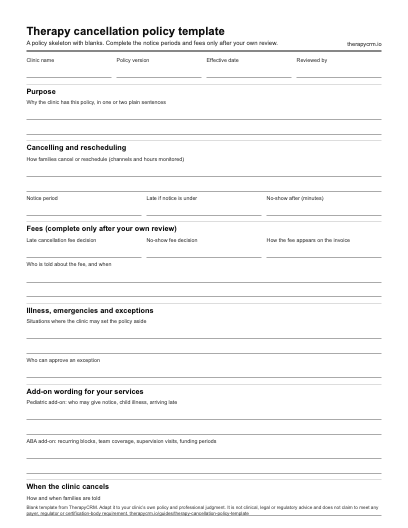
A policy skeleton with blanks. Complete the notice periods and fees only after your own review. The blank PDF prints on US Letter paper (2 pages) and the Word document can be edited to match your clinic’s fields. Both are free to download with no sign-up.
What a cancellation policy should settle
A written policy does not need to be long. It needs to say, in plain words, how families cancel or reschedule, how much notice the clinic asks for, what counts as a late cancellation and a no-show, whether a fee applies, and who can make an exception. The clinic decides each of these, so the wording on this page leaves every number and fee as a placeholder.
Families read a policy at intake and again when something goes wrong. A short policy with a worked situation is easier to follow than a long one, and it is easier for front-desk staff to apply the same way each time.
- How to cancel or reschedule, and which channels staff actually monitor
- The notice period, written as hours or business days, and what counts as late
- What counts as a no-show, including how long staff wait before marking one
- Whether a fee applies and how it appears on the invoice
- How illness, emergencies and weather are handled
- What the clinic does when it cancels a visit
- How many late changes trigger a conversation before the clinic acts
- Who can approve an exception
Fill-in policy wording with placeholders only
Copy the rows into the clinic’s own document and replace every bracketed item. Where the wording says a fee decision, the clinic chooses between no fee, a set fee or a forfeited visit credit, after reading the regulator and funder notes further down.
| Policy part | Wording to adapt |
|---|---|
| Purpose | Visits at [clinic name] are reserved for your child. This policy explains how to change a visit and what happens when a visit is missed. |
| How to cancel or reschedule | Contact [clinic name] by [channels] at least [notice period] before the visit. Messages sent outside [office hours] are read on the next business day. |
| Late cancellation | A cancellation with less than [notice period] notice is a late cancellation. [Fee decision: none, a set fee or a forfeited visit credit.] |
| No-show | If your child does not arrive within [number] minutes of the start time and we have not heard from you, we may mark the visit as a no-show. [Fee decision.] |
| Illness and emergencies | If your child is unwell or an emergency happens, tell us as soon as you can. [Clinic rule for setting this policy aside, and who decides.] |
| Repeated changes | If visits are changed late [number] times in [period], [clinic contact] will talk with you about a schedule that works for your family. |
| Funded visits | Some funders do not pay for missed or cancelled visits. [Clinic wording on what the family pays directly and how it appears on the invoice.] |
| Acknowledgement | Signing or confirming below tells us you have read this policy. [Policy version and the date it was given to the family.] |
Square brackets mark text the clinic must replace or delete. None of the wording states a required notice period or fee.
Pediatric clinic wording for late cancellation and no-show visits
Pediatric clinics deal with a parent or guardian rather than the client, children who are unwell at short notice, and families who see more than one therapist on the same day. These additions cover those cases and sit alongside the core wording above.
| Situation | Wording to adapt |
|---|---|
| Who gives notice | A parent or guardian listed on your child’s file may cancel or reschedule. [Clinic rule for other adults.] |
| Child illness | If your child has [symptoms the clinic lists], please keep them home and tell us. We will [reschedule, or offer a make-up visit within the clinic’s make-up window]. |
| Arriving late | Please arrive [number] minutes before the visit. If you are running late, contact [clinic contact]; we may shorten the visit or move it. |
| Several therapists in one day | If your child sees more than one therapist on the same day and you must cancel one visit, tell us so we can [adjust the rest of the day]. |
ABA cancellation policy wording for session blocks
ABA visits are often recurring blocks that involve a behaviour technician, a supervisor and sometimes parent-training time. A cancellation can ripple across several schedules, so an ABA cancellation policy usually names the sessions it covers. The funding-period line is where a clinic explains what happens to make-up visits that would fall outside a family’s funding period.
| Situation | Wording to adapt |
|---|---|
| Recurring blocks | Your child’s sessions are scheduled as a recurring block of [days and hours]. A cancellation applies to the sessions you name in your message. |
| Team coverage | A block can involve a behaviour technician and a supervisor, so a late cancellation can affect more than one person’s schedule. [Clinic wording, or none.] |
| Supervision and parent-training visits | Supervisor and parent-training visits are scheduled separately and follow this policy unless [clinic rule]. |
| Funding periods | [Clinic wording on make-up visits that would fall after a funding period ends, and on who pays for them.] |
When the clinic cancels: staff make-up wording
A policy that only describes what families owe reads as one-sided. Add the clinic’s own commitments so families know what to expect when a clinician is ill, a room is unavailable or the clinic closes.
| Situation | Wording to adapt |
|---|---|
| Clinic cancels | If [clinic name] has to cancel a visit, we will tell you by [channel] as early as we can and offer [a make-up visit, a credit or a refund, per clinic decision]. |
| Make-up window | A make-up visit offered by the clinic can be booked within [number] days of the cancelled visit. |
| Clinician absence | If your child’s regular clinician is away, we may offer a visit with [another qualified clinician] or a later date. |
| Family charge | No family charge for a visit the clinic cancels. [Clinic confirms.] |
| Record keeping | Staff note the reason for the change and the make-up offer on the schedule. |
Check fees, packages and funders before you publish
No single rule sets a cancellation fee or a no-show fee for therapy visits at every clinic. The first check is each clinician’s own regulator, and the examples below come from Ontario regulators and the Ministry that runs the Ontario Autism Program. They do not cover other provinces or every profession.
The College of Physiotherapists of Ontario standard says a physiotherapist confirms the patient has a comprehensive fee schedule before any fee applies, and that the schedule covers cancellation or late fees and refund policies [R1]. For prepaid or bundled physiotherapy services, the same standard lists offering one service at a time, refunds for unused services and issuing receipts only after services are delivered [R1]. A clinic that sells packages should read it before writing a refund line.
The College of Psychologists and Behaviour Analysts of Ontario standards say registrants reach an agreement with payers about fees and payment arrangements before providing services, and may charge a fee for a missed appointment or late cancellation if they informed clients of the practice in advance and notice was not given within an agreed period [R2]. Those are conditions on a fee, not a requirement to charge one.
Funders can be stricter than regulators. The Ontario Autism Program guidelines list cancellation fees for missed or cancelled sessions among the ineligible expenses [R3]. A family cannot report such a fee as an Ontario Autism Program expense, so a clinic that charges one can keep it on its own invoice line and tell the family before service that it is their own cost. That layout is our suggestion, not a ministry rule.
Ask the clinic’s accountant about tax treatment and its counsel about enforceability. The fee and receipt rules table lists what each regulator’s published standard says, with official links.
Official sources
- [R1] College of Physiotherapists of Ontario, Funding, Fees and Billing Standard. Effective August 1, 2025.
- [R2] College of Psychologists and Behaviour Analysts of Ontario, Standards of Professional Conduct (2024). In force July 1, 2024; practical applications updated May 5, 2026. Sections 15.1 and 15.3.
- [R3] Ontario Ministry of Children, Community and Social Services, Ontario Autism Program guidelines for core clinical services and supports. Page updated September 10, 2026; see the list of ineligible expenses.
Give the policy to families and apply it the same way
A policy only works if families see it before the first visit and staff apply it consistently. Add it to the intake package, record which version each family received, and give front-desk staff a one-page guide to exceptions. Consent and intake wording belongs to the clinic’s own forms.
Keep the family-facing policy separate from the notes staff use when they decide a case. If staff waive a fee, record who decided and why, so the pattern is visible when the policy is reviewed.
How TherapyCRM handles reminders, no-shows and cancellation fees
TherapyCRM sends email and SMS appointment reminders about a day and an hour before a visit. Text messages go only to families who have consented to them. Reminders and the schedule sit beside the policy, but the policy wording itself stays the clinic’s own.
A practice can have TherapyCRM mark a visit as a no-show automatically when no arrival is recorded after a grace period the practice sets; the default is 30 minutes and the setting can be switched off. A recorded arrival, for example a check-in on TherapyCRM Kiosk, stops the automatic no-show. Staff can also mark a no-show by hand and can revert one.
When a visit is marked as a no-show, TherapyCRM sends the family a missed-visit message unless notifications are turned off for that visit. The default email includes a general line saying the practice has a no-show policy and that repeated no-shows may lead to fees or affect booking, so a clinic with no fee policy should read that wording before relying on automatic no-shows.
TherapyCRM does not add a cancellation or no-show fee to an invoice automatically. A clinic that charges one adds a line itself. The billing catalog has a Cancellation fee category, and services in that category default to ineligible for Ontario Autism Program funding.
TherapyCRM serves English-language practices in Canada outside Quebec. It is practice management software with a clinical record, not a physician EMR, and has no EMR certification. It has no telehealth or video visits and does not submit insurance or government claims, including Ontario Autism Program claims.
Adapt and review the policy before use
Replace all placeholders, read the wording aloud as a family would hear it, and check it against your regulator and funders. Keep each version with the date it took effect. No part of this page states a required notice period, fee or tax rate.
Frequently asked questions
What should a therapy cancellation policy include?
It should say how families cancel or reschedule, how much notice the clinic asks for, what counts as a late cancellation and a no-show, whether a fee applies, how illness and emergencies are handled, what the clinic does when it cancels, and who can approve an exception. The blank template covers each of these with placeholders.
How much notice should a therapy clinic ask for?
This page gives no recommended notice period, because the right one depends on the service, the schedule and the clinic’s regulator. Choose a period the clinic can explain, write it as hours or business days, and apply it the same way for every family.
Can a therapy clinic charge a late cancellation or no-show fee?
It depends on the profession and the funder, so check each clinician’s regulator. Two Ontario examples: the physiotherapy college expects a fee schedule covering cancellation or late fees before any fee applies [R1], and the psychology and behaviour analysis college allows a missed-appointment or late-cancellation fee when clients were told in advance and notice was not given within an agreed period [R2]. A fee is a clinic decision, not a requirement.
Does the Ontario Autism Program pay cancellation fees?
No. The Ontario Autism Program guidelines list cancellation fees for missed or cancelled sessions as ineligible expenses [R3]. A clinic that charges one can show it separately so the family can see which amounts they may report.
What about refunds for prepaid packages?
Package and refund rules vary by profession. The Ontario physiotherapy college standard lists offering one service at a time, refunds for unused services and receipts only after delivery for prepaid or bundled services [R1]. Check the regulator for every discipline the clinic offers before selling a package.
Is the policy wording ready to use as written?
No. Every notice period and fee is a placeholder, and the wording is a fictional starting point. Replace the placeholders, ask counsel about enforceability and an accountant about tax treatment, and keep a record of the version each family received.
Does TherapyCRM charge no-show or cancellation fees automatically?
No. TherapyCRM does not add a cancellation or no-show fee to an invoice by itself; staff add a line if the clinic decides to charge one. It can mark a no-show automatically after a grace period the practice sets, and the practice can switch that off.
Does TherapyCRM send appointment reminders?
Yes. TherapyCRM sends email and SMS appointment reminders about a day and an hour before a visit, and text messages go only to families who have consented. The reminder wording and the cancellation policy remain the clinic’s own choices.