For Canadian practices outside Quebec
BCBA supervision log template for Ontario ABA clinics
A BCBA supervision log template records each supervision contact between a supervisor and the people they supervise. This Ontario version has a field for each item that the College of Psychologists and Behaviour Analysts of Ontario (CPBAO) lists for supervision records, and it uses job-title wording that avoids Ontario’s restricted titles.
Fictional example only. Adapt this to your clinic’s own policy and professional judgment. It is not clinical, legal or regulatory advice and does not claim to meet any payer, regulator or certification-body requirement. Ontario title and supervision-record wording comes from the official pages listed under Official sources, read on 8 October 2026; confirm it with the College before relying on it.
Last checked: 2026-10-08
Download a printable ABA supervision log template (PDF or Word)
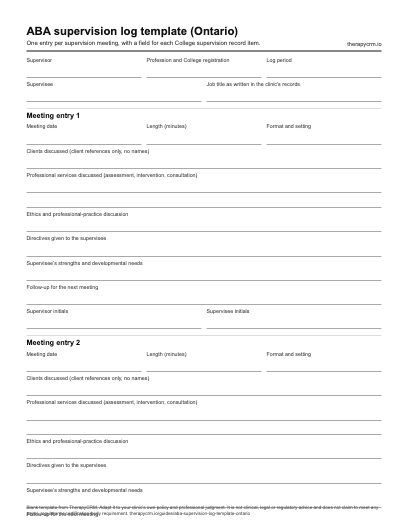
One entry per supervision meeting, with a field for each College supervision record item. The blank PDF prints on US Letter paper (2 pages) and the Word document can be edited to match your clinic’s fields. Both are free to download with no sign-up.
What an ABA supervision log is for
An ABA supervision log is the clinic’s running record of supervision contacts: when a supervisor met a supervisee, for how long, which clients were discussed, what was covered and what the supervisor asked the supervisee to do next. It is a clinic document. It is not a credential-body fieldwork form, and it does not replace any duty the supervisor has to their regulator.
People who search for a BCBA supervision log template often have a United States certification context in mind, where the Behavior Analyst Certification Board (BACB) sets its own supervision and fieldwork documentation. This page does not describe those requirements. In Ontario, the College regulates behaviour analysis, and the CPBAO FAQs report that the BACB announced that from 1 July 2026 Ontario residents can no longer apply for BCBA certification or take the exam [R2]. Check the BACB’s current materials if you need its forms.
Which titles to use on an Ontario supervision log
The Psychology and Applied Behaviour Analysis Act, 2021 reserves the titles “psychologist”, “psychological associate” and “behaviour analyst”, including variations and abbreviations, for College members, and it bars non-members from holding themselves out as qualified to practise in those professions [R1]. The CPBAO FAQs add that a non-member who uses the “Behaviour Analyst” title, indicates any certification or designation, or otherwise communicates that they are qualified as a behaviour analyst could be in violation of the Act, and that only College-registered behaviour analysts use the BCBA credential in Ontario [R2].
The FAQs also say that the activities of a behaviour analyst are not controlled or restricted acts, so the question for an unregistered team member is how they are titled and described. The College gives examples, not a closed list, of less ambiguous titles for unregulated staff: Supervised Instructor, Supervised Instructor-Therapist, Supervised Therapist and Supervised Interventionist [R2]. This log uses the plain description “behaviour technician” for the role. It is a description, not a title the College has approved, so the log has a field where the clinic writes the exact job title it uses, and the clinic should ask the College whether that title could be read as holding out.
| Role in the log | Wording to use | Why |
|---|---|---|
| Supervisor who is a registered behaviour analyst | “Behaviour analyst”, with the College registration as shown on the public register | Only College members may use the title [R1]. |
| Supervisor who is a psychologist or psychological associate | “Psychologist” or “psychological associate” | These are also restricted titles [R1]. The College’s chart says psychologists, psychological associates and behaviour analysts can each supervise ABA services of unregistered providers [R2]. |
| Team member who is not registered with the College | A plain role description such as “behaviour technician”, or a title from the College’s examples, checked with the College | The Act restricts specific titles, and the College asks unregistered staff to avoid confusion about their status [R1][R2]. |
| A BCBA or BCBA-D credential held by a non-member | Ask the College before showing it in a title or description of services | The College says only registered behaviour analysts use the BCBA credential in Ontario [R2]. |
The Act restricts the titles, not this template. The clinic should ask the College about any title it plans to use.
What the College says supervision records must include
The CPBAO Standards of Professional Conduct, in force since 1 July 2024 with practical applications updated on 5 May 2026, say that supervising registrants must keep comprehensive records of supervision activities and contacts with supervisees. Standard 4.5.1 lists six minimum items [R3]. The log has a field for each one.
The Standards also say a client’s name need not appear in a supervision record as long as the record has enough information to identify which client was discussed, and that initials or a client identification number can do this [R3]. The log asks for a client reference for that reason.
On retention, the Standards say supervision records must be kept for at least ten years after the last relevant clinical contact for any client discussed or, if that client was under 18 at the last contact, for ten years after the day the client became or would have become 18 [R3]. The retention comparison page sets the Ontario college rules beside the rules in the other provinces.
| Supervision record item in Standard 4.5.1 | Field in this log |
|---|---|
| Date and length of each supervision meeting | Meeting date and length |
| Details that identify each client discussed | Clients discussed (client reference) |
| Summary of discussion about professional services, such as assessment, intervention and consultation | Professional services discussed |
| Summary of discussion about ethics and jurisprudence | Ethics and professional-practice discussion |
| Directives given to the supervisee | Directives given |
| The supervisee’s strengths and developmental needs | Strengths and developmental needs |
The left column paraphrases the Standards; read Standard 4.5.1 for the exact text. A field for each item does not show that a clinic meets the Standards.
Fictional supervision log entry
The supervisor, supervisee, clients and discussion below are invented. They show how a clinic might fill in the fields. They are not a recommended supervision plan, a meeting frequency or a clinical decision.
| Field | Fictional entry |
|---|---|
| Supervisor | Supervisor A, behaviour analyst registered with the College |
| Supervisee and job title | Supervisee B, behaviour technician (the job title as written in the clinic’s own records) |
| Meeting | Meeting 6: in person, 45 minutes, observation of one session followed by a discussion |
| Clients discussed (reference only) | Client A and Client C |
| Professional services discussed | Reviewed Client A’s break-card data from four sessions and the current prompt step. Looked at how Client C’s session notes describe what happened before the behaviour. |
| Ethics and professional-practice discussion | How to answer a caregiver who asks about progress: pass the question to the supervisor and avoid giving an opinion on the plan. |
| Directives given | Record the prompt level on every trial. Send each session note for review by the end of the shift. |
| Strengths and developmental needs | Strength: consistent data entry. Developmental need: waiting a few seconds after the instruction before prompting. |
| Follow-up | Review Client C’s notes together at meeting 7. |
All names, counts and observations are fictional.
Blank ABA supervision log template for Ontario clinics
Copy this layout, or use the printable log and editable Word file in the download section. Add one entry for each meeting, and keep the log with the supervisor’s records under the clinic’s policy.
| Field | Fill in for your clinic |
|---|---|
| Supervisor | [Name, profession and College registration as shown on the public register] |
| Supervisee and job title | [Name and the job title written in the clinic’s own records] |
| Meeting date and length | [Date and minutes] |
| Format | [In person, video or phone; individual or group; observation or record review] |
| Clients discussed | [Client references only, no names] |
| Professional services discussed | [Assessment, intervention and consultation topics] |
| Ethics and professional-practice discussion | [Topics raised and any conclusion] |
| Directives given | [What the supervisee was asked to do, and by when] |
| Strengths and developmental needs | [Observations from this meeting] |
| Follow-up | [Items for the next meeting] |
| Sign-off | [Supervisor and supervisee initials under clinic policy] |
Other supervision documents the Standards mention
A log records meetings. The Standards also describe documents that a log does not replace [R3]. Under Standard 4.1, the clients receiving supervised services are the supervisor’s clients. Questions about how these standards apply to a particular clinic belong with the College.
- A written supervision agreement for each supervisory relationship, signed by the supervisor and the supervisee, with items such as the effective and expected end dates, each person’s duties, how often and for how long meetings are expected and a way to resolve disputes (Standard 4.4).
- Information for clients and other relevant parties about the direct service provider’s supervision status and credentials, how to reach the supervisor and who the health information custodian is (Standard 4.3).
- The supervisor’s name and contact details on reports and formal correspondence about supervised services, and the supervisor’s co-signature on documents that may reasonably be relied on to make decisions affecting client care, rights or welfare (Standards 4.5.3 and 4.5.4).
- Billing and receipts in the name of the supervising registrant, a professional corporation or the employer, with invoices and receipts naming the supervising registrant and the supervised provider’s name, degrees and professional designations (Standard 4.5.5).
Using the log week to week
These are working suggestions for a clinic. They are not requirements from the College.
- Fill in the entry when the meeting ends, while the discussion is fresh.
- Use client references that match the clinic’s own record system, so the supervisor can find the client record.
- Keep ethics topics short and factual, and leave out client health details beyond what identifies the client.
- Store the log with the supervisor’s records, and decide under clinic policy whether the supervisee receives a copy.
- Before each review point, scan the log for clients who have not been discussed and directives that have not been followed up.
Related ABA clinic documents
Session data, treatment plans and session notes are separate documents from a supervision log. The ABA session notes guide, the Ontario ABA regulation guide and the ABA clinic pages show how those pieces fit together. Keep this log wherever the clinic stores supervision records.
Where these Ontario rules come from
We opened each page below on 8 October 2026. The e-Laws page shows a currency date of 6 October 2026, the CPBAO FAQs page shows no date, and the Standards PDF shows 1 July 2024 as the date in force and 5 May 2026 for its practical applications. If a page has moved or changed, rely on the College and the e-Laws consolidation.
Official sources
- [R1] Psychology and Applied Behaviour Analysis Act, 2021, S.O. 2021, c. 27, Sched. 4 (e-Laws). Section 8, restricted titles and holding out; e-Laws currency date 6 October 2026.
- [R2] College of Psychologists and Behaviour Analysts of Ontario, FAQs. Titles, job-title examples, BCBA credential, supervision chart; no page date shown.
- [R3] College of Psychologists and Behaviour Analysts of Ontario, Standards of Professional Conduct (2024). Standard 4, supervision; in force 1 July 2024, practical applications updated 5 May 2026.
Frequently asked questions
What should an ABA supervision log include in Ontario?
The CPBAO Standards list six minimum items for a supervising registrant’s supervision records: the date and length of each meeting, details that identify the clients discussed, a summary of professional services discussed, a summary of ethics and jurisprudence discussions, directives given and the supervisee’s strengths and developmental needs [R3]. A clinic may add fields.
What job title can an unregistered ABA team member use in Ontario?
The Act restricts “behaviour analyst”, “psychologist” and “psychological associate” to College members [R1]. The College gives Supervised Instructor, Supervised Instructor-Therapist, Supervised Therapist and Supervised Interventionist as examples of less ambiguous titles, and says non-members who present themselves as qualified behaviour analysts could be in violation of the Act [R2]. Ask the College about any title you plan to use.
How long should supervision records be kept in Ontario?
The Standards say at least ten years after the last relevant clinical contact for any client discussed or, if the client was under 18 at that contact, ten years after the day the client became or would have become 18 [R3].
Can I use a BCBA supervision log template from the United States?
A United States form follows a certification body’s rules, which this page does not describe. In Ontario the College’s Standards apply to its registrants, and the College says only registered behaviour analysts use the BCBA credential in Ontario [R2][R3]. Use the form your regulator or credential body asks for, and use this log as the clinic’s own record.
Do client names go in a supervision log?
The Standards say a name is not necessary as long as the record identifies the client discussed, and they give initials or a client identification number as examples [R3]. This log asks for a client reference.
Who can supervise ABA delivered by unregistered providers in Ontario?
The College’s chart says psychologists, psychological associates and behaviour analysts can each supervise ABA services of unregistered providers [R2]. Funders may set their own provider rules, so check those as well.
Does this log replace a supervision agreement?
No. The Standards separately call for a signed supervision agreement for each supervisory relationship, with items such as duties, meeting frequency and a mechanism for resolving disputes [R3].
Can I download the blank supervision log?
Yes. The PDF prints on US Letter paper and the Word document can be edited to match the clinic’s fields. Both are free to download with no sign-up and contain no client data.