For Canadian practices outside Quebec
Preference assessment documentation and reinforcement records
A preference record documents what was offered, accessible and selected in a particular context. A reinforcement record documents an authorized arrangement and subsequent observed responding. A choice alone does not establish that an option functions as a reinforcer. This original pack organizes the records without supplying an assessment or treatment protocol.
Fictional example only. Adapt this to your clinic’s own policy and professional judgment. It is not clinical, legal or regulatory advice and does not claim to meet any payer, regulator or certification-body requirement.
Last checked: 2026-10-10
Download a printable preference and outcome record pack (PDF or Word)
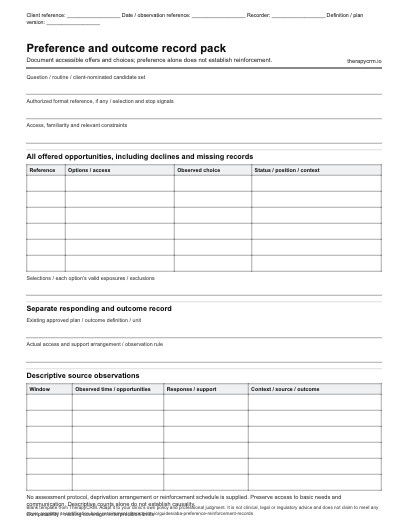
Document accessible offers and choices; preference alone does not establish reinforcement. The blank PDF prints on US Letter paper (2 pages) and the Word document can be edited to match your clinic’s fields. Both are free to download with no sign-up.
Keep preference, accessibility and reinforcement distinct
Vanderbilt TRIAD explains that preferences can change and that a preferred option is not necessarily a demonstrated reinforcer [PREF1]. Record the person’s own nominated interests and available communication forms rather than assume staff-selected items represent what matters to them.
Options may be inaccessible because of vision, reach, communication, sensory, health or material constraints. Mark an inaccessible option rather than treating it as rejected. Preserve ordinary access to communication, food, water, comfort and breaks; a record sheet does not authorize restricting basic needs or testing an option the person declines.
Complete the choice and outcome record step by step
If a qualified clinician has selected a formal assessment format, record its name, approved procedure reference and version; use the authorized materials directly. This generic pack is not a paired-stimulus, MSWO, MSW or free-operant assessment protocol.
- Write the question, routine, date, recorder, client-nominated candidate set and current plan reference.
- Define accessible selection, rejection and stop signals. Note prior exposure, recent access and relevant constraints.
- Record all options offered on each opportunity, position or representation where relevant, actual accessibility and the observed choice.
- Preserve no selection, a declined offer, an invalid opportunity and a missed record as different states.
- Summarize selections against each option’s valid exposure opportunities rather than the number of rows alone.
- Keep an outcome record only for the separately authorized arrangement, using the target definition, observation time, support and reviewer decision.
Completed fictional preference observation
Client G nominates drawing and a block activity during a leisure planning conversation. The invented definition accepts a spoken choice or pointing to the accessible option, and accepts “neither” as a valid choice. This is an informal choice log, not a formal comparison assessment. Every offer and status is shown.
Swipe or scroll sideways to view all table columns.
| Offer | Options/access | Observed choice | Status/context |
|---|---|---|---|
| 1 | Drawing and blocks; both accessible | Drawing | Valid; client initiated leisure planning |
| 2 | Drawing and blocks; both accessible | Neither | Valid offer; client chose a break |
| 3 | Drawing and blocks; both accessible | Blocks | Valid; different position from offer 1 |
| 4 | Drawing present; blocks unavailable | Drawing | Invalid for comparing both options; access unequal |
| 5 | Both options reportedly offered | Unknown | Not observed by recorder; no choice score |
| Summary | 3 valid comparable offers | Drawing 1; blocks 1; neither 1 | One invalid comparison; one missing observation |
Calculate choice summaries and keep their limits visible
Across the three valid comparable offers, drawing was selected on 1 of 3 offers and blocks on 1 of 3: each is 33.3%. The third valid offer produced a “neither” choice and remains visible in the denominator. The inaccessible offer and missed observation do not become rejections. The tiny invented log supports no stable hierarchy.
If an option was presented fewer times than another, state each option’s valid exposure denominator. Formal formats have their own presentation and scoring rules; do not merge rankings from different formats, candidate sets or sessions into one preferred-item score. Record a change in the candidate set or access arrangement under a new version.
Common mistakes include treating no choice as missing without explanation, omitting declined offers, assuming a food preference is permission to use food contingently, and calling the most selected option a proven reinforcer. Review the person’s communication and experience alongside the count.
Completed fictional outcome record without a causal claim
For an already authorized, fictional plan REC1, the recorder separately logs independent requests for a chosen drawing activity during two comparable ten-minute leisure windows. The existing plan and access arrangement remain unchanged; these observations do not demonstrate a reinforcement effect.
Swipe or scroll sideways to view all table columns.
| Window | Observation time | Independent requests | Context and outcome |
|---|---|---|---|
| A | 10 fully observed minutes | 2 | Drawing freely available; no additional prompt recorded |
| B | 10 fully observed minutes | 3 | Drawing freely available; no additional prompt recorded |
| Review | Same measure and duration | Counts 2 and 3 retained separately | More data and clinician interpretation needed; no causal conclusion |
This log does not compare experimental conditions, prescribe a schedule or establish that drawing is a reinforcer.
Use the sheet, tools and clinical record together
Use fictional or deidentified information in the public tools. Keep identifiable observations and completed forms in the practice-approved clinical record under the clinic’s access, retention and amendment policies.
A public worksheet helps prepare and inspect a recording format. It does not authorize a treatment, decide mastery, replace consent or turn a draft into a reviewed clinical record. A clinician should confirm definitions, denominators and interpretation before the team uses the form.
TherapyCRM serves English-language practices in Canada outside Quebec. It is practice management software with a clinical record, not a physician EMR, and has no EMR certification. It has no telehealth or video visits and does not submit insurance or government claims, including Ontario Autism Program claims.
Sources and scope of this original resource
The blank record and every worked entry are original TherapyCRM examples. Sources explain the professional topic; they do not endorse this template. School resources and research studies require interpretation by a qualified clinician for a real clinic. No standardized assessment, publisher form or licensed guideline is reproduced.
Source references
- [PREF1] Vanderbilt TRIAD: Preference Assessments. Explains choice, changing preferences and the distinction between preference and reinforcement. Checked 10 October 2026. The original record below is not the TRIAD assessment or its decision flowchart.
- [ONT1] CPBAO: Standards of Professional Conduct. Ontario standards in force 1 July 2024, with practical applications updated 5 May 2026; checked 10 October 2026. Relevant sections address competence, consent, records and assessment. They apply to Ontario registrants and supervised services, not automatically to every province.
Frequently asked questions
Is a preference assessment the same as a reinforcer assessment?
No. Preference concerns choices or engagement with options. Demonstrating a reinforcement effect concerns subsequent responding under an appropriately evaluated arrangement.
Does this pack include an MSWO assessment protocol?
No. It is an original documentation layout. A qualified clinician selects the format and uses its authorized procedure and scoring rules directly.
How should declined choices be recorded?
Keep the offered options, accessible communication and observed decline visible. Do not conceal it as a blank row or require participation to complete a form.
What if one option could not be reached or used?
Record the access problem and its effect on comparability. Do not count an inaccessible option as rejected.
How are selection percentages calculated?
State the selected option’s valid exposure denominator and the chosen format’s rules. In the informal example, each option was selected once across three valid comparable offers.
Does a higher response count prove reinforcement?
No. Context, access, support, observation coverage and other explanations matter. Two descriptive records do not establish a causal effect.