For Canadian practices outside Quebec
Caregiver coaching, FCT and naturalistic opportunity records
A caregiver coaching note records shared priorities, what was discussed or practised and what the family agreed to review. A naturalistic opportunity log records communication and participation in everyday routines. If the approved plan includes functional communication training (FCT), keep its plan reference and communication response visible rather than treating every request as FCT.
Fictional example only. Adapt this to your clinic’s own policy and professional judgment. It is not clinical, legal or regulatory advice and does not claim to meet any payer, regulator or certification-body requirement.
Last checked: 2026-10-10
Download a printable caregiver and communication pack (PDF or Word)
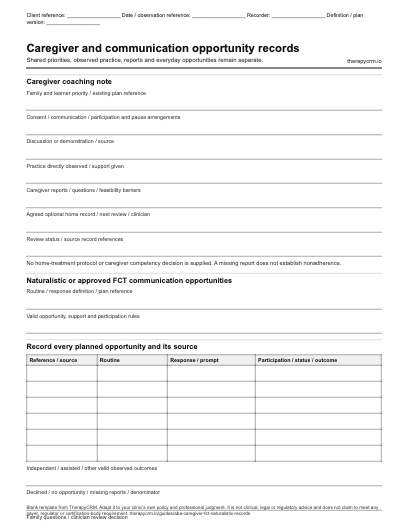
Shared priorities, observed practice, reports and everyday opportunities remain separate. The blank PDF prints on US Letter paper (2 pages) and the Word document can be edited to match your clinic’s fields. Both are free to download with no sign-up.
Document an agreed plan rather than prescribing home treatment
Naturalistic-intervention resources describe learning opportunities in everyday contexts [NET1]. FCT specifically concerns a communication response linked to an assessed function; it requires assessment, clinical competence and an individualized plan [FCT2]. A request observed in play alone does not establish that an FCT procedure was used.
This record supplies no extinction, response-blocking, deprivation, reinforcement-thinning or safety protocol. Document the approved plan reference, available communication, ongoing participation and when to seek clinician review. Keep access to AAC, needed breaks and basic needs independent of completing the sheet.
Prepare and complete the caregiver coaching note
Use a short record that the family and clinician find feasible. A missed practice log can reflect access, time, misunderstanding or a missing report; it cannot by itself establish nonadherence.
- Ask the family and learner which routine or question matters; record their wording and agreed priority.
- Confirm the current plan reference, consent arrangements, communication forms and individualized participation or stop signals.
- Record what the clinician explained or demonstrated, what the caregiver chose to practise and what was directly observed.
- Separate a caregiver’s report from clinician observations, and document the actual support provided during practice.
- Agree on a feasible home record, questions or adaptations; preserve declined activities and barriers without blame.
- Record the next review point, responsible clinician and the family’s questions. Do not auto-label the caregiver competent from a checklist.
Completed fictional caregiver coaching note
The following invented note concerns arranging a family-selected drawing routine. The clinical content and follow-up are illustrative entries, not home-treatment instructions.
Swipe or scroll sideways to view all table columns.
| Field | Fictional entry |
|---|---|
| Shared priority | Caregiver and Client J want help requests understood during drawing |
| Existing plan and participation | Plan COMM1; speech and agreed symbol available; “stop” and turning away documented as pause signals |
| Discussion | Clinician reviewed the existing response definition and accessible materials |
| Practice observed | Caregiver recorded three opportunities with clinician coaching; one correction concerned a prompted response |
| Caregiver report | Caregiver described one unrecorded home request; labelled report only |
| Question/barrier | Family asked for a shorter record; evening timing was difficult |
| Agreed next step | Family chose to bring questions and any optional routine notes to the scheduled review |
| Review status | Draft reviewed by fictional clinician; no caregiver competency or treatment outcome conclusion |
Completed fictional FCT or NET opportunity log
The fictional plan COMM1 defines a help request as speech or the agreed symbol during drawing. The record below is an opportunity log for that plan. It documents the arrangement without stating an assessed function or claiming this log itself proves an FCT effect. All four planned opportunities and the reporting source are shown.
Swipe or scroll sideways to view all table columns.
| Opportunity/source | Routine | Response/support | Participation and result |
|---|---|---|---|
| 1 / direct observation | Drawing material selection | Spoken help request; independent | Participation continued; staff assisted with materials |
| 2 / direct observation | Opening chosen pencil case | Symbol request after gestural reminder | Assisted response; access provided |
| 3 / direct observation | Drawing setup | Client said “stop” before a valid help opportunity | Declined activity; paused; not a failed help response |
| 4 / expected home report | Family-selected drawing routine | Unknown | No report received; missing observation record |
| Summary | Two valid directly observed help opportunities | 1 independent; 1 assisted | 1 ÷ 2 = 50% independent; one decline and one missing report disclosed |
Separate communication, coaching and coverage outcomes
The learner’s request, the caregiver’s implementation and the clinician’s coaching are different observations. If monitoring caregiver implementation, define the expected observable actions from the approved plan and record assistance, applicable opportunities and missing items separately. A child’s response does not automatically establish caregiver fidelity.
For the communication example, the decline and missing report remain visible beside the two valid opportunities. The denominator rule is explicit and chosen only for this illustration. Excluding declined activity can change the apparent percentage, so always report it and review whether the measure answers the family’s question.
Common mistakes include writing “parent understands” without an observation, counting an assisted response as independent, imposing a quota of home opportunities, and copying a procedure from a handout into the plan. Record what happened, who reported it and what the clinician and family will review.
Use the sheet, tools and clinical record together
Use fictional or deidentified information in the public tools. Keep identifiable observations and completed forms in the practice-approved clinical record under the clinic’s access, retention and amendment policies.
A public worksheet helps prepare and inspect a recording format. It does not authorize a treatment, decide mastery, replace consent or turn a draft into a reviewed clinical record. A clinician should confirm definitions, denominators and interpretation before the team uses the form.
TherapyCRM serves English-language practices in Canada outside Quebec. It is practice management software with a clinical record, not a physician EMR, and has no EMR certification. It has no telehealth or video visits and does not submit insurance or government claims, including Ontario Autism Program claims.
Sources and scope of this original resource
The blank record and every worked entry are original TherapyCRM examples. Sources explain the professional topic; they do not endorse this template. School resources and research studies require interpretation by a qualified clinician for a real clinic. No standardized assessment, publisher form or licensed guideline is reproduced.
Source references
- [NET1] AFIRM: Naturalistic Intervention. Publisher-authored 2017 educational packet archived by ERIC; background on everyday contexts and monitoring. Original TherapyCRM documentation examples do not reproduce its protocol, checklist or data sheet.
- [FCT1] AFIRM: Functional Communication Training. Publisher-authored 2017 educational packet archived by ERIC; background on communication responses, monitoring and transfer across contexts. This guide does not reproduce or prescribe its treatment procedures.
- [FCT2] Tiger, Hanley and Bruzek: Functional Communication Training. 2008 research review describing assessment, implementation and generalization considerations. Linked as clinical background, not as instructions to implement a treatment from a template.
Frequently asked questions
What should an ABA caregiver coaching note include?
Record shared priorities, the approved plan, discussion or practice, directly observed support, caregiver reports, questions, barriers and the agreed review point.
Are NET data and DTT data interchangeable?
No. Everyday opportunities and structured trials may have different context and denominator rules. Record the method and valid opportunity definition before summarizing.
Does every communication request count as FCT?
No. FCT involves an individualized assessment and plan linking communication to an assessed function. A generic request log does not establish that clinical relationship.
How do I record a family’s declined practice activity?
Preserve the decline and context, respect the agreed participation plan and discuss feasible alternatives. Do not silently score it as a failed response.
Does an absent home log mean the family did not practise?
No. It means the expected report is missing. Ask about feasibility and access and distinguish no report from a documented no-opportunity day.
Can this template replace caregiver competency assessment?
No. It organizes documentation. Any competency or treatment decision requires the appropriate clinician, individual plan and assessment process.